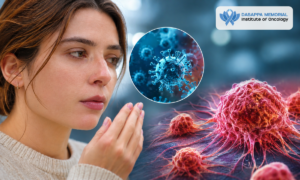
Can you get cancer by kissing someone, sharing food, or drinking from the same glass? No. Cancer itself is not contagious and cannot spread from one person to another through saliva or everyday social contact.
However, there is an important distinction worth understanding. Certain infections, including the Epstein-Barr virus (EBV) and human papillomavirus (HPV), can spread between people and are associated with an increased risk of developing specific cancers. This does not mean cancer itself is transmitted.
At Dasappa Cancer Hospital, we understand that questions about cancer transmission can cause concern for patients, families, and caregivers. In this article, we explain whether cancer can spread through saliva, what role infections play, and what you should know about the actual risks.
Key points
- Cancer itself is not generally contagious.
- Saliva does not transmit cancer in normal social interactions.
- Some infections, such as EBV and HPV, can spread between people and may raise the risk of certain cancers in a minority of those infected.
- Having one of these infections does not mean you will get cancer.
- Persistent symptoms should be checked by a doctor.
For a broader look at common misconceptions, see our article on cancer myths and facts.
Can Cancer Spread Through Saliva?
Cancer begins inside a person’s own body, when cells acquire changes in their genetic material and start growing without normal control. Those cells are adapted to that one person’s body.
In everyday contact, cancer cells from one person do not establish cancer in another person. Cancer is therefore fundamentally different from an infectious disease, and ordinary social contact with a patient does not make anyone “catch” their cancer.
Cancer transmission ≠ transmission of a cancer-associated infection.
Keeping these two ideas separate resolves most of the worry around this topic.
Is Cancer Contagious Through Kissing or Sharing Food?
Can you get cancer from kissing someone?
No. Kissing someone who has cancer does not pass the cancer on. If the person has an infection such as EBV, that infection can spread through kissing. That is a different matter, and it does not mean you will get cancer (more on this below).
Can sharing food or drinks cause cancer?
No. Sharing plates, glasses, spoons or a meal does not cause cancer. Neither does hugging, holding hands, sharing a room, or looking after a family member through treatment. Patients often feel isolated by this misconception, so it is worth stating plainly: they do not need to eat alone or keep their distance from the people they love.
Can saliva transfer cancer cells?
In people with some oral cancers, a few tumour cells or fragments of tumour DNA can be found in saliva. Researchers actually study saliva for this reason, as a possible tool for early detection. Finding cancer-related material in saliva is not the same as being contagious. In everyday contact, those cells do not survive and establish a tumour in another person.
Why Do People Associate Saliva With Cancer?
The link is understandable, and it comes from three facts:
- Saliva can carry certain infections.
- Some of those infections are associated with a higher risk of specific cancers.
- People then assume the cancer itself must be passing from person to person.
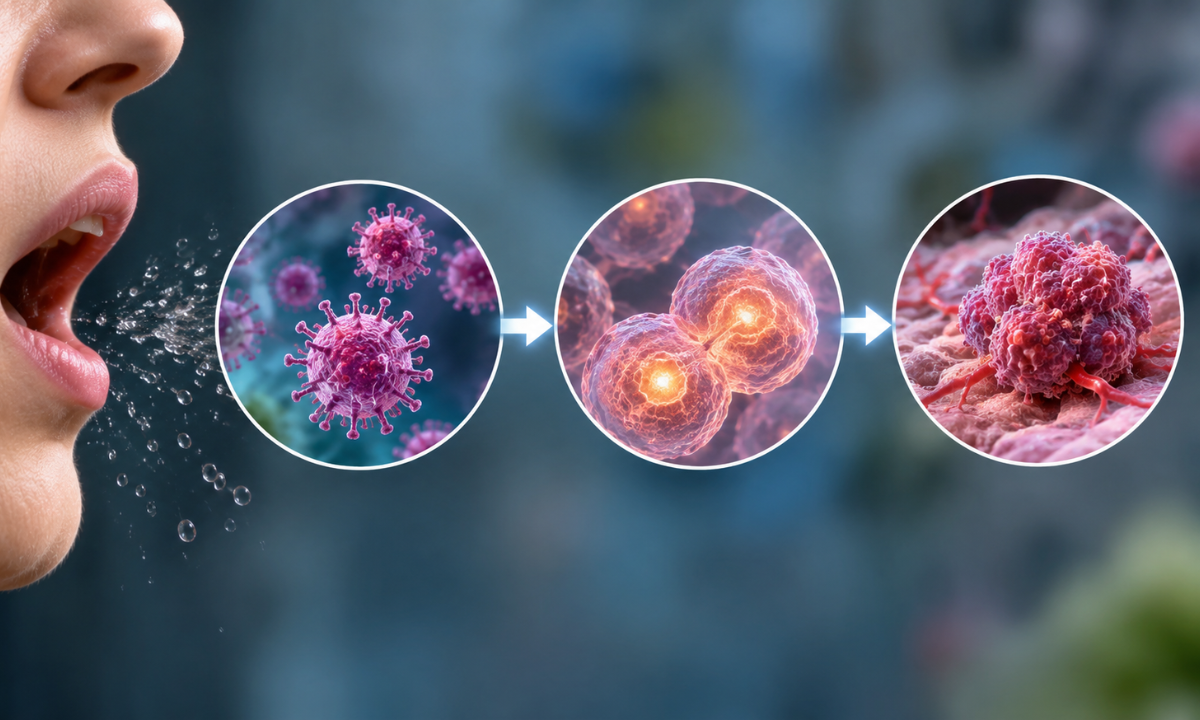
The actual chain looks like this:
Infection → long-term infection or biological changes in cells → increased cancer risk in some people
It does not look like this:
Person with cancer → saliva → another person’s cancer
Can Saliva Transmit Infections Linked to Cancer?
Yes, some infections that spread through saliva are linked to cancer.
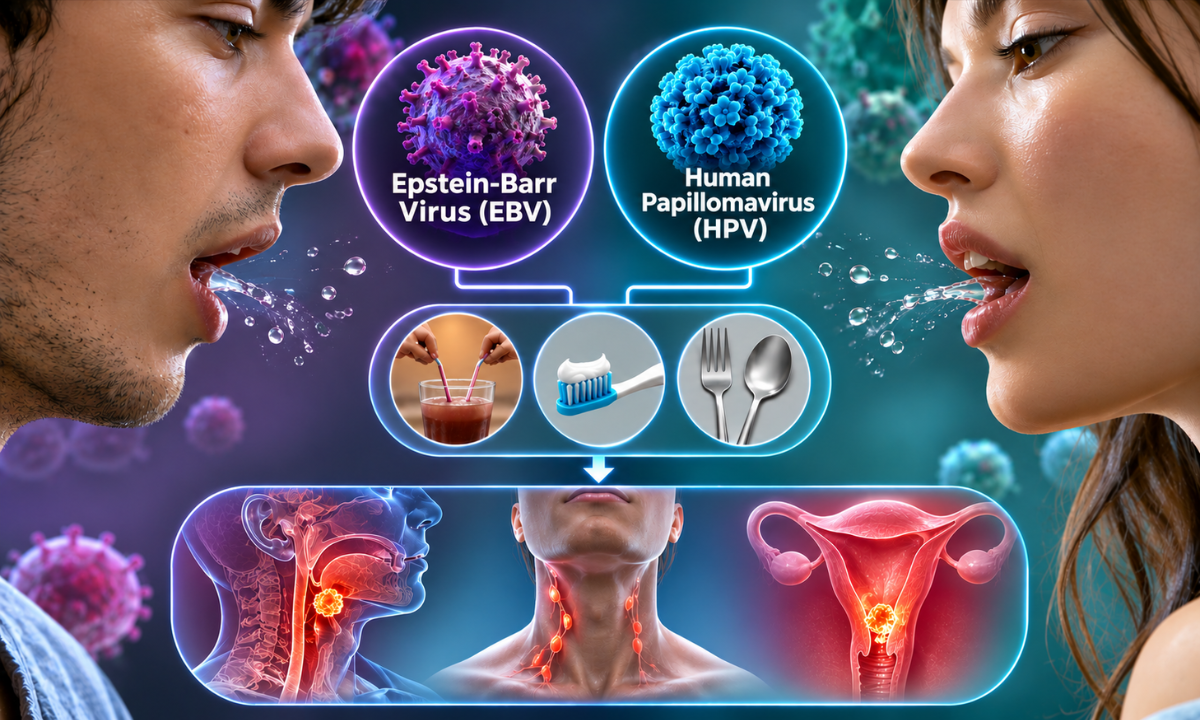
Epstein-Barr Virus (EBV)
EBV is a very common virus, and most people worldwide are infected at some point, often in childhood. It spreads mainly through saliva, which is why mononucleosis is sometimes called “the kissing disease.” Sharing drinks, utensils or toothbrushes can also spread it.
Most people who carry EBV never develop any related disease. In a small number of people, EBV infection is associated with an increased risk of certain cancers, including nasopharyngeal cancer (cancer at the back of the nose and throat) and some lymphomas such as Burkitt lymphoma.
Having EBV does not mean you will get cancer. It is one risk factor among several, and for the overwhelming majority of people it stays quiet for life.
Human Papillomavirus (HPV)
HPV is a large group of related viruses. Most types are harmless and clear on their own. A smaller number are “high-risk” types, and when these infections persist over years they can lead to cancers of the cervix, anus, genitals and the oropharynx (the middle part of the throat, including the tonsils and base of the tongue). HPV 16 is the type most strongly associated with HPV-related cancers.
HPV mainly spreads through intimate skin-to-skin and sexual contact, including oral sex. It is not primarily spread through casual contact or by sharing food or drinks.
Having HPV is not the same as having cancer. Most infections are cleared or controlled by the immune system without any problem.
HPV vs EBV: What Is the Difference?
| Factor | HPV | EBV |
|---|---|---|
| What is it? | Virus | Virus |
| Main route of spread | Intimate and sexual contact | Saliva (kissing, shared utensils and drinks) |
| Can it be linked to cancer? | Yes (including throat, cervical and anal cancers) | Yes (including nasopharyngeal cancer and some lymphomas) |
| Does infection mean cancer? | No | No |
| Is the cancer itself contagious? | No | No |
| Vaccine available? | Yes (HPV vaccine; availability and schedules vary by country and age) | Not currently approved |
| Most relevant here | HPV-related throat cancers | Nasopharyngeal cancer, certain lymphomas |
This table is for general education and is not a substitute for medical advice.
Does Having HPV or EBV Mean You Will Get Cancer?
No. This is important, because it is easy to swap one myth for another.
- Infection is not cancer. Most HPV and EBV infections never lead to cancer.
- The immune system usually copes. Many HPV infections are cleared or controlled within a couple of years.
- Cancer is multifactorial. It usually takes years and a combination of factors, not one infection alone.
- Other risks matter. Depending on the cancer, tobacco, alcohol, a weakened immune system, genetics and other exposures can all add to the risk.
The sensible takeaway is awareness and prevention, not fear.
Can Cancer Spread From One Person to Another?
People use the phrase “cancer spread” for two different things.
Metastasis (within one body). Cancer can spread from where it started to other parts of the same person’s body, through the bloodstream or lymphatic system. This is how cancer becomes advanced.
Contagious transmission (between people). This does not happen in normal life. A cancer patient cannot give their cancer to a family member, partner or friend.
Are There Any Rare Exceptions?
There are a few extremely rare medical situations. The best-documented is organ transplantation, where cancer cells from a donor’s organ have very rarely been passed to a recipient. Transplant teams screen donors carefully, and recipients take medicines that suppress the immune system, which is what makes this possible.
These situations are fundamentally different from everyday contact such as kissing, sharing meals, hugging or drinking from the same glass. They are not a reason to worry in normal life.
What About Oral Cancer and Saliva?
Oral cancer starts from abnormal cells in the tissues of the mouth, such as the tongue, gums, cheeks or floor of the mouth. Saliva does not make it contagious.
What does matter:
- Tobacco (smoked or chewed) and alcohol are major risk factors for oral and head and neck cancers, and the risk is higher when they are combined.
- Some HPV infections are associated with cancers of the throat and oropharynx.
- Persistent changes in the mouth deserve a proper medical evaluation rather than waiting and hoping.
Our guide to head and neck cancer explains oral and oropharyngeal cancers, their symptoms, risk factors and stages.
When Should You See a Doctor?
The question is not whether you caught cancer from someone’s saliva. It is whether you have a symptom that has not gone away. See a doctor if you notice any of these for more than two to three weeks:
- A mouth sore or ulcer that does not heal
- A lump or thickened area in the mouth, neck or throat
- Unexplained bleeding in the mouth
- Persistent difficulty or pain when swallowing
- Hoarseness that does not improve
- Unexplained neck swelling
- A persistent sore throat
- Unexplained weight loss
These symptoms have many causes, and most are not cancer. But persistent ones need an evaluation, and early diagnosis makes treatment more effective.
How Can You Reduce Your Risk of Cancer-Associated Infections?
- HPV vaccination. HPV vaccines prevent infection with the HPV types most likely to cause cancer. Eligibility, vaccine products and dosing schedules vary by age, location and current public-health guidance. Ask a doctor or local immunisation service what is appropriate for you or your child. Our guide to HPV vaccination, screening and early detection explains the current situation in India.
- Avoid tobacco in every form. This is the single most important step for oral and head and neck cancer risk.
- Limit alcohol. Alcohol and tobacco together increase risk more than either alone.
- Practise safer sexual health. Condoms and limiting the number of partners reduce the chance of HPV and other infections, though they do not eliminate it.
- Attend recommended screening. What is appropriate depends on your age, sex, risk factors and the cancer type, so ask your doctor.
- Get persistent symptoms checked. Avoid self-diagnosing or waiting for symptoms to settle on their own.
For wider guidance, read about cancer prevention and early detection.
Common Questions About Cancer and Saliva
1. Can cancer be transmitted through saliva?
Keep this as your primary FAQ. It directly addresses the main search intent.
2. Can you get cancer by kissing someone with cancer?
Keep. People commonly worry about this, and it addresses a specific concern.
3. Can cancer cells be present in saliva?
Keep. This is a useful scientific question that adds information beyond the basic reassurance.
4. Can EBV spread through saliva?
Keep. It introduces the important distinction between transmitting an infection and transmitting cancer.
5. Can HPV cause throat cancer?
Keep. This adds relevant information about infection-related cancer risk.
6. Does having HPV mean I have cancer?
Keep. This addresses a common misconception and complements the HPV question.
Key Takeaway: Cancer Is Not the Same as a Cancer-Associated Infection
- Cancer itself is not generally contagious.
- Saliva does not transmit cancer in normal social interactions.
- Some infections, including EBV and HPV, can be passed between people and may raise the risk of certain cancers in a minority of those infected.
- Having one of these infections does not mean you will get cancer.
- Vaccination, avoiding tobacco, limiting alcohol and getting persistent symptoms checked are the practical steps that help.
If you or a family member has a symptom that has not settled, our team can help. Visit the Dasappa Cancer Hospital homepage to learn about our cancer care, or read more about head and neck cancer.
Medical disclaimer: This article is for general information only and is not a substitute for professional medical advice, diagnosis or treatment. Consult a qualified doctor about any health concern.
Sources: