
People diagnosed with bone cancer, and their families, naturally want to know what the future may hold. The honest answer is that prognosis, the likely course and outcome of the disease, cannot be read from a single test result. It is shaped by several things working together: the type of bone cancer, how far it has spread, the size and location of the tumour, how the cells look under the microscope, the patient’s health and how the cancer responds to treatment.
This is why two people with the same diagnosis can have very different outlooks. It is also why survival statistics, which describe large groups of people, cannot predict what will happen to one person. This guide explains the seven main factors doctors consider, how they are assessed and how primary bone cancer differs from cancer that has spread to the bones.
What Does Bone Cancer Prognosis Mean?
Prognosis is a doctor’s estimate of how a disease is likely to behave and respond to treatment. It is an informed assessment, not a promise. It takes into account the features of the cancer, the patient’s overall health and the treatment options available.
Two related terms are often mixed up. Survival rate is a statistic, such as the proportion of people alive five years after diagnosis. Life expectancy is an estimate of how long a person is expected to live. A five-year relative survival rate compares people with a cancer to people in the general population of the same age, to estimate how much the cancer affects survival.
Is Prognosis the Same as a Survival Rate?
No. A survival rate describes a group of patients treated in the past. Prognosis is about one person, and it can change as new information arrives, for example after surgery or a scan that shows how the tumour responded. For some bone sarcomas, particularly osteosarcoma and Ewing sarcoma, the amount of tumour killed by chemotherapy before surgery, known as the pathological response, can provide important prognostic information.
7 Major Factors That Affect Bone Cancer Prognosis
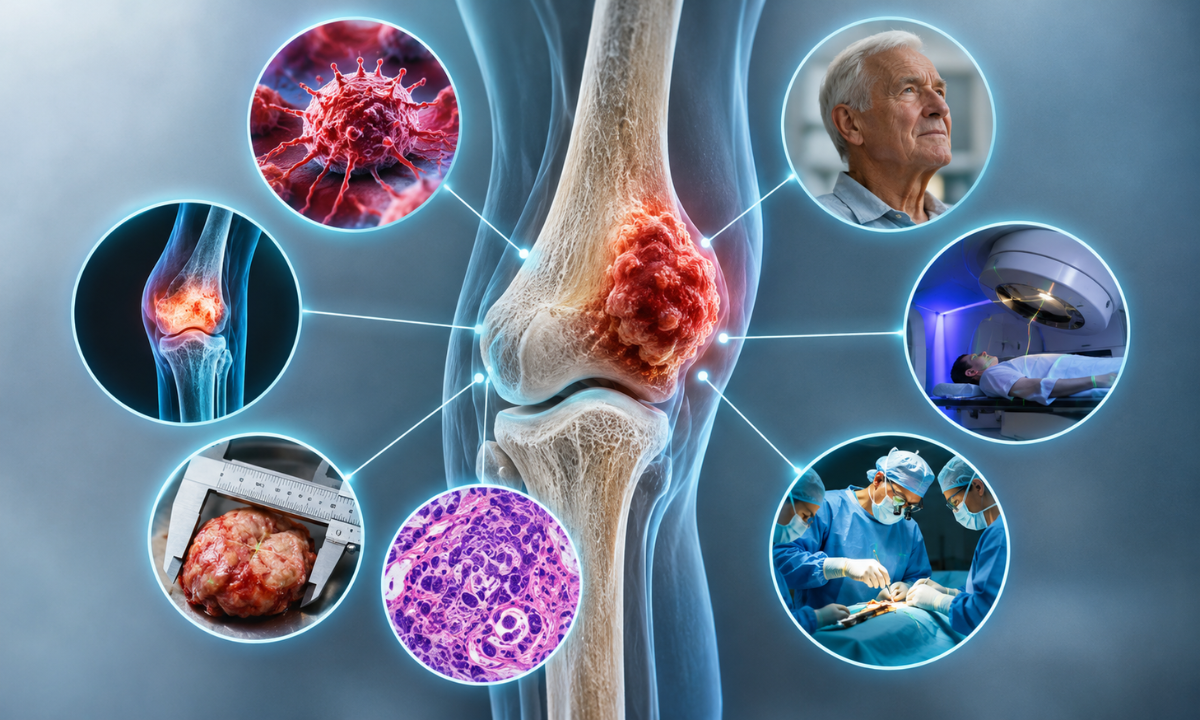
1. Type of Bone Cancer
Primary bone cancers are a group of different diseases, including:
- Osteosarcoma: a common primary malignant bone tumour, particularly in children, adolescents and young adults.
- Ewing sarcoma: a small round-cell sarcoma that can arise in bone or soft tissue, most often in children, adolescents and young adults.
- Chondrosarcoma: a malignant cartilage-forming tumour, more common in adults.
- Chordoma: a rare tumour that typically arises in the spine or the base of the skull.
- Other rare bone sarcomas.
Each type behaves differently and responds differently to treatment, so an outlook cannot be applied across all bone cancers.
2. Cancer Stage and Whether It Has Spread
Stage describes how far the cancer has travelled. Doctors generally distinguish between disease that is localised to the bone, disease that has extended to nearby tissue and disease that has spread to distant parts of the body. For osteosarcoma and Ewing sarcoma, the lungs are a common site of metastatic spread, and other bones may also be involved. The usual pattern of spread differs by tumour type.
The presence of metastatic disease generally makes treatment more complex and can influence the outlook, although many patients with spread still respond to treatment. For a general explanation of staging, see our guide to understanding cancer stages.
3. Tumour Size and Location
Smaller tumours are often easier to remove completely than large ones. Location matters as well. Tumours in an arm or leg are often more accessible to surgery, while tumours in the pelvis or spine lie close to vital nerves, blood vessels and organs, which can limit surgical options. Involvement of nearby structures can also make complete removal harder.
4. Tumour Grade and Cell Characteristics
Grade describes how abnormal the cancer cells look under the microscope and how quickly they are likely to grow. Lower-grade tumours often grow more slowly, while higher-grade tumours tend to be more aggressive, although the meaning of grade and its effect on treatment vary by tumour type. The pathology report gives this information, which is why an accurate biopsy and a careful reading of the report are so important.
5. Age and Overall Health
Fitness for treatment, existing medical conditions, nutrition and functional status affect which treatments are possible and how well they are tolerated. Age may be relevant in some tumour types, but it does not determine the outcome on its own, and doctors look at the whole person when planning treatment.
6. Response to Treatment
How a tumour responds to treatment is one of the most informative factors. In some bone cancers, especially osteosarcoma and Ewing sarcoma, chemotherapy is given before surgery. The pathologist then assesses how much tumour has been destroyed. A good pathological response is encouraging and may help guide further treatment, although it does not guarantee an outcome. For other bone cancers, particularly many chondrosarcomas, surgery and complete removal may be the main treatment, and chemotherapy may not be part of routine care. Follow-up scans track changes in tumour size and activity over time. To learn how doctors tailor therapy, read about personalised cancer treatment and our chemotherapy treatment services.
7. Whether the Tumour Can Be Completely Removed
For many primary bone cancers, complete removal of the tumour with clear margins is central to local control. The feasibility of limb-sparing surgery depends on the tumour’s location, size, involvement of nerves, blood vessels and joints, and the planned reconstruction. When complete removal is not possible without unacceptable functional loss, the multidisciplinary team, including surgeons, medical and radiation oncologists, radiologists and pathologists, will discuss the available options and goals of care.
Does the Type of Bone Cancer Change the Prognosis?
Yes, considerably. The table shows what doctors tend to weigh most for each type.
| Bone cancer type | Important prognostic considerations |
|---|---|
| Osteosarcoma | Metastases, tumour location, size and response to chemotherapy |
| Ewing sarcoma | Extent of spread, tumour location and treatment response |
| Chondrosarcoma | Grade, tumour location and extent |
| Chordoma | Location, extent and whether complete removal is possible |
Because the factors that matter most differ by type, advice found online for one bone cancer may not apply to another. Ask your oncologist how the findings apply to your specific diagnosis.
How Do Bone Cancer Stages Affect Survival?

In general, disease confined to its original site is more likely to be treated with curative intent than disease that has spread. However, “stage” does not mean the same thing for every primary bone cancer.
For osteosarcoma and Ewing sarcoma, doctors commonly distinguish localised disease from metastatic disease. Staging usually includes imaging of the primary tumour, chest imaging to look for lung metastases, and whole-body imaging where appropriate. For chondrosarcoma and chordoma, tumour grade, local extent and whether the tumour can be completely removed are especially important.
Accurate staging depends on imaging, biopsy and pathology, and it should be interpreted by a multidisciplinary team.
What Is the Survival Rate for Bone Cancer?
Survival rates are usually reported as five-year relative survival. They differ between bone cancer types, and they generally differ by whether the disease is localised or has spread to distant sites.
These figures have important limits. They describe groups of people treated years earlier, so they may not reflect current treatments. Many widely quoted survival figures come from large registries in the United States and other high-income countries, and they may not reflect the treatments, access to care or population characteristics relevant to patients in India. If you come across numbers, look for ones that match the exact diagnosis, subtype, stage, treatment era and population, and discuss them with your doctor rather than relying on a single figure.
Can Bone Cancer Prognosis Improve With Early Diagnosis and Treatment?

Early evaluation gives treatment the best chance to work, though it cannot guarantee a particular result. Persistent bone pain, swelling or a lump that does not settle deserves timely medical attention. The pathway usually includes:
- Appropriate imaging
- A biopsy and pathology confirmation
- Accurate staging
- Multidisciplinary treatment planning
- Individualised treatment with regular monitoring
Our solid cancer treatment page describes how Dasappa approaches these tumours.
How Do Doctors Assess Bone Cancer Prognosis?
Doctors build the picture step by step:
- History and examination: symptoms, medical history and a physical check.
- Imaging: X-ray, MRI and CT to see the tumour and look for spread.
- Biopsy and pathology: confirms the type and grade.
- Staging: determines how far the cancer has spread.
- Tumour characteristics: size, location and relation to nearby structures.
- Treatment response: assessed with scans and pathology.
- Multidisciplinary discussion: specialists review everything together.
Does Bone Cancer Prognosis Differ From Bone Metastasis?
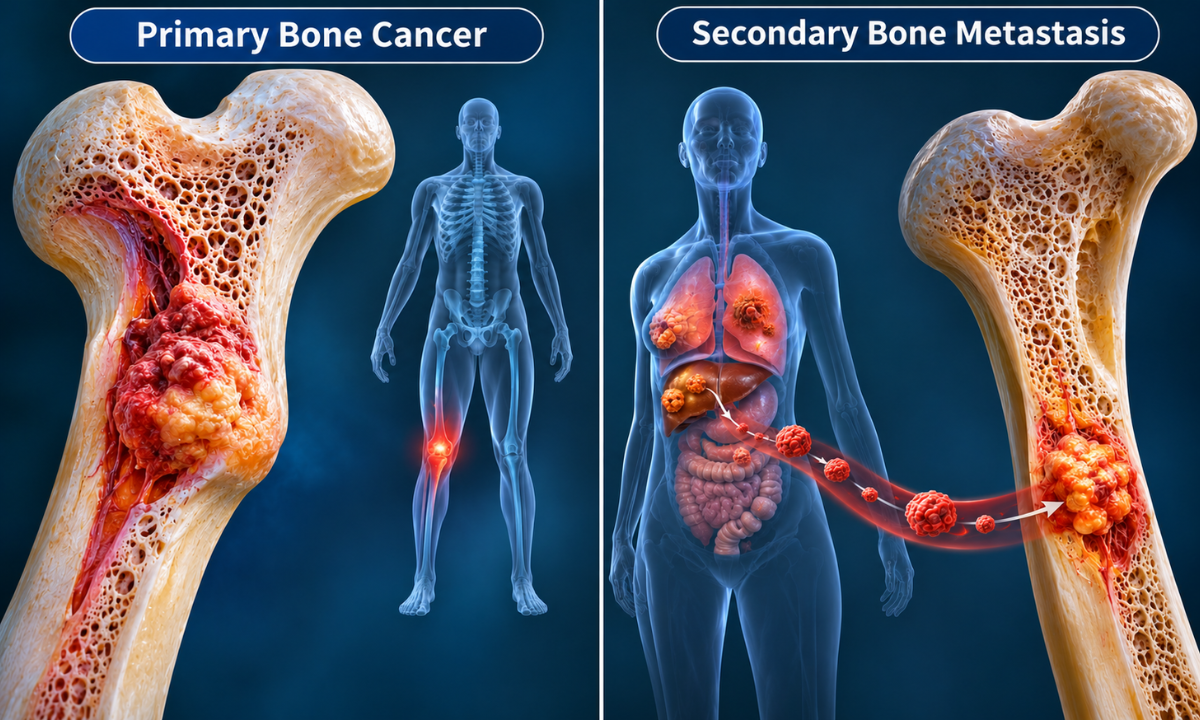
Yes, and the difference is important. Primary bone cancer begins in the bone tissue itself. Bone metastasis happens when cancer that started elsewhere, such as the breast, prostate or lung, spreads to the bones.
They are treated differently and have different outlooks. With bone metastasis, the type of the original cancer is a major influence on what can be done. Statistics and prognostic factors discussed in this article apply to primary bone cancer, not to cancer that has spread to bone from another organ. For that topic, read our article on bone metastasis and its treatment.
Frequently Asked Questions About Bone Cancer Prognosis
What factors affect bone cancer prognosis most?
The type of bone cancer, stage and spread, tumour size and location, grade, age and health, response to treatment and whether the tumour can be completely removed. No single factor decides the outcome.
Can bone cancer be cured if detected early?
Some primary bone cancers can be cured, particularly when they are localised, completely removed and treated with an appropriate multidisciplinary plan. The chance of cure depends on the tumour type, grade, stage and response to treatment.
Does bone cancer stage determine life expectancy?
Stage is important but is only one factor. Type, grade, location, treatment response and general health also matter, and individual life expectancy cannot be predicted from stage alone.
Which type of bone cancer has a better prognosis?
This varies. Outcomes depend on the type, the grade and whether the disease is localised, so comparing types in general terms is not very helpful for any one patient. Even within one diagnosis, outcomes vary substantially by stage, grade, location and response to treatment.
Can metastatic bone cancer patients respond to treatment?
Yes. Some patients with spread to other parts of the body respond to treatment, though the outlook is usually more guarded and treatment is more complex.
Does chemotherapy response affect bone cancer survival?
In some bone cancers, especially osteosarcoma and Ewing sarcoma, how well the tumour responds to chemotherapy is an important prognostic indicator and may influence further treatment.
Can bone cancer return after treatment?
Yes. Recurrence is possible, which is why regular follow-up with examination and imaging is advised after treatment ends.
How often should patients have follow-up after bone cancer treatment?
Schedules vary with the type of cancer and treatment, and are typically more frequent in the first years. Your oncology team will set a plan for you.
Conclusion
Bone cancer prognosis depends on many connected factors, including cancer type, grade, stage, tumour location, treatment response and overall health. Statistics can give general context, but they cannot describe your own situation. Discuss your pathology report, staging results and treatment options with your oncology team. At Dasappa, patients benefit from a multidisciplinary approach in which specialists plan care together around the individual.