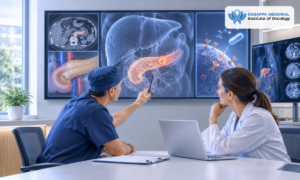

Receiving a malignant diagnosis immediately shifts a patient into a highly complex clinical environment. Securing an evaluation at an advanced Cancer Treatment Hospital in Bangalore remains the absolute most critical action for establishing a definitive medical trajectory.
Recognized as the Best Cancer Hospital in Bangalore, Dasappa Cancer Hospital delivers elite multidisciplinary intervention.
Patients frequently require the immediate diagnostic expertise of a specialized Surgical Oncologist in Bangalore, such as Dr Pandu Dasappa, to address severe localized pathologies. Optimizing your initial consultation with oncologist specialists fundamentally transitions your care from diagnostic uncertainty directly into a structured clinical action plan.
According to the clinical frameworks established by the American Society of Clinical Oncology, a successful initial evaluation requires meticulous patient preparation. This medical appointment is not a standard introductory meeting; it is a highly rigorous, data-driven strategy session.
To maximize the clinical efficacy of this critical diagnostic milestone, patients must systematically prepare for the following evaluation phases:
- Clinical Portfolio Verification: A comprehensive medical analysis of all existing biopsy pathology reports, genetic sequencing data, and cross-sectional radiological imaging.
- Multidisciplinary Staging: Precisely determining the exact biological progression of the disease to accurately sequence the required surgical and systemic interventions.
- Strategic Patient Alignment: Establishing absolute diagnostic clarity to ensure the patient completely understands the immediate treatment timeline, surgical options, and pharmacological protocols.
Anticipating this precise clinical structure, patients can actively participate in their medical management and significantly accelerate the initiation of highly targeted oncological therapies.
Assembling Your Clinical Portfolio and What to Bring?

Arriving at your initial consultation completely prepared fundamentally alters the trajectory of your appointment.
A surgical oncologist does not simply review a generalized summary; they meticulously analyze raw biological and structural data to formulate an exact clinical strategy. Providing incomplete records forces the medical team to order duplicate testing, strictly delaying the initiation of critical interventions.
To ensure your oncology team can immediately map the progression of your disease, you must systematically compile a comprehensive clinical portfolio. Medical professionals categorize these required documents into three distinct diagnostic pillars.
The Essential Clinical Documentation Checklist
I. Pathological Evidence (Cellular Data)
This represents the absolute foundation of your diagnosis. Without microscopic confirmation, an oncologist cannot authorize targeted therapies or invasive surgeries.
- Complete Biopsy Reports: Provide the exact laboratory pathology reports detailing the microscopic evaluation of any extracted tissue.
- Surgical Operative Notes: If you have already undergone a preliminary surgical resection or a complex diagnostic biopsy, secure the exact surgical notes detailing the internal physical findings.
- Molecular and Biomarker Testing: Include any advanced genetic sequencing or receptor status reports. This highly specific data strictly determines your biological eligibility for advanced immunotherapies or targeted pharmacological agents.
II. Radiological Imaging (Structural Mapping)
Written interpretations of scans are insufficient for comprehensive surgical planning. The oncology team must independently evaluate the raw structural data to stage the internal physical boundaries of the malignancy accurately.
- Physical Digital Media: Procure the actual CDs or USB drives containing the DICOM (Digital Imaging and Communications in Medicine) files for all relevant imaging.
- Comprehensive Scan History: Bring all recent Computed Tomography (CT), Magnetic Resonance Imaging (MRI), Positron Emission Tomography (PET), and advanced ultrasound data.
- Corresponding Written Reports: Provide the official clinical interpretations from the reviewing radiologists to accompany the raw digital files.
III. Systemic Health History (Physiological Baseline)
Before a surgical oncologist authorizes complex mechanical extraction or systemic chemical intervention, they must strictly verify your overall physiological stability.
- Current Pharmacological Profile: Document every active prescription, over-the-counter medication, and supplemental vitamin you currently consume, including exact biological dosages.
- Comprehensive Medical History: Provide a detailed chronology of all prior non-oncological surgeries, chronic cardiovascular or respiratory conditions, and severe drug allergies.
- Familial Oncology History: Document any verified malignancies within your immediate genetic lineage, as this strictly informs the necessity for further genetic screening.
Securing this precise clinical data transforms your initial consultation from an exploratory meeting into a definitive, strategy-focused medical evaluation.
The Clinical Assessment Meeting Your Oncology Specialists
Arriving at the consultation introduces the patient to a highly specialized multidisciplinary medical board. At an advanced facility like Dasappa Cancer Hospital, a single physician does not independently dictate your complete medical trajectory. Instead, a coordinated team of specialists strictly evaluates your clinical portfolio.
During this initial assessment, each specialist analyzes the biological data through a distinct therapeutic lens to formulate a unified intervention strategy.
To understand the exact clinical structure of this meeting, patients must recognize the distinct medical roles present during the evaluation.
The Multidisciplinary Oncology Evaluation Board
| Specialist Classification | Primary Clinical Focus | Diagnostic Objective During Consultation |
|---|---|---|
Surgical Oncologist | Physical localized tumor extraction | Determining anatomical resectability and planning precise microscopic surgical margins |
Medical Oncologist | Systemic pharmacological intervention | Evaluating exact biological eligibility for targeted chemotherapy or advanced immunotherapy |
Radiation Oncologist | Localized cellular destruction | Calculating precise external radiation dosing to significantly shrink the primary structural mass |
When consulting specifically with a Surgical oncologist, the clinical evaluation centers entirely on physical anatomical boundaries.
This specialist does not merely decide if a physical surgery is possible. They must strictly determine if surgically removing the malignant mass provides a definitive survival advantage without causing catastrophic systemic biological damage.
To make this critical surgical determination, the oncologist strictly evaluates three distinct anatomical parameters
- Anatomical Resectability: The specialist maps the exact physical proximity of the localized tumor to major cardiovascular structures and critical internal neural pathways.
- Microscopic Surgical Margins: The evaluation must guarantee that the surgical team can physically extract the entire visible tumor along with a strict perimeter of completely healthy biological tissue.
- Functional Organ Preservation The surgeon mathematically calculates the exact volume of functional biological tissue remaining after the proposed extraction to ensure continuous systemic physiological stability.
Meticulously analyzing these specific physical parameters, the surgical team strictly defines the immediate mechanical intervention required before authorizing any subsequent systemic chemical therapies.
The Diagnosis, Staging, and Pathology
During the initial consultation, the oncology team must translate raw microscopic laboratory data into a highly structured biological framework. This specific clinical process establishes the exact severity of the malignant disease.
Patients frequently receive overwhelming amounts of complex medical terminology during this phase. The surgical oncologist fundamentally simplifies this data by dividing the diagnosis into two distinct clinical categories, strictly defined as cellular grading and structural staging.
Pathological grading strictly evaluates the internal microscopic behavior of the malignant cells.
A clinical pathologist examines the extracted tissue biopsy to determine how closely the mutated cells physically resemble standard healthy biological tissue.
- Low Grade Malignancies: The extracted cells appear structurally similar to healthy tissue, strictly indicating a statistically slower biological replication rate.
- High Grade Malignancies: The cellular samples present severe structural mutations strictly indicating highly aggressive biological proliferation requiring immediate advanced intervention.
While pathological grading identifies the microscopic cellular behavior, structural staging definitively maps the macroscopic physical boundaries of the disease. Oncologists universally utilize a highly specific standardized mathematical matrix to categorize physical malignant progression.
The Standardized Tumor Node Metastasis Staging Matrix
| Diagnostic Metric | Clinical Definition | Surgical Implication |
|---|---|---|
| Tumor Boundary | Quantifies the exact physical size and structural tissue penetration of the primary malignant mass | Strictly dictates the exact required perimeter for safe microscopic surgical resection |
| Lymph Node Involvement | Determines if the malignant cells have physically migrated into the localized regional lymphatic drainage system | Mandates the immediate physical extraction of surrounding localized immune structures to prevent systemic cellular transit |
| Systemic Metastasis | Confirms the physical presence of malignant cellular replication entirely outside the primary anatomical origin | Fundamentally alters the treatment pathway from localized surgical extraction to immediate systemic chemical therapy |
Systematically establishing these precise pathological and structural parameters, the oncologist creates a definitive biological blueprint. This exact diagnostic clarity strictly dictates the absolute necessity for immediate surgical intervention versus initiating targeted systemic pharmacological management.
Questions you should be asking your Oncologist
An oncology consultation is not a passive medical lecture. It strictly requires active patient participation. To guarantee absolute comprehension regarding the proposed biological trajectory, patients must actively interrogate the medical data.
Utilizing a structured clinical checklist ensures the patient and the medical board maintain exact diagnostic alignment. Medical professionals strongly encourage patients to document specific inquiries before arriving at the facility.
When addressing the multidisciplinary team, you must specifically direct these critical questions to oncology consultant specialists to establish absolute clinical clarity.
Structured Clinical Inquiry Matrix
| Inquiry Category | Specific Patient Question | Clinical Rationale for Inquiry |
|---|---|---|
| Diagnostic Validation | What is the exact cellular grade and structural stage of this malignancy? | Establishes the precise biological severity and macroscopic physical boundaries of the disease |
| Surgical Necessity | Am I a viable candidate for immediate physical tumor resection? | Determines if the medical team prioritizes mechanical extraction over initial systemic pharmacological therapy |
| Therapeutic Options | What specific clinical alternatives exist if I decline the primary proposed intervention? | Ensures the patient completely understands all available evidence-based medical pathways and their respective statistical outcomes |
| Systemic Consequences | What exact physiological deficits will this treatment permanently cause? | Quantifies the guaranteed biological damage required to successfully eradicate the malignant cellular growth |
| Timeline Execution | When exactly must I initiate this specific medical protocol to prevent further cellular metastasis? | Strictly defines the biological chronological window available before the disease physically advances beyond the current structural stage |
Addressing these specific clinical parameters, patients actively seek comprehensive medical transparency. This structured interrogation transforms a period of severe psychological uncertainty into a definitive clinical action plan strictly dictated by evidence-based medical science.
Why Choose Dasappa Cancer Hospital? Comprehensive Oncology Care Under Dr Pandu Dasappa

Selecting the appropriate facility for an initial oncology evaluation fundamentally alters long-term clinical outcomes. As the Best Cancer Hospital in Bangalore, Dasappa Cancer Hospital provides an unparalleled multidisciplinary diagnostic environment.
Patients requiring complex localized tumor evaluations secure direct access to elite surgical specialists, including Dr Pandu Dasappa, a highly renowned Surgical Oncologist in Bangalore.
By conducting your initial consultation at our specialized Cancer Treatment Hospital in Bangalore, you secure several distinct clinical advantages.
- Advanced Surgical Infrastructure: Our facility features specialized surgical suites engineered specifically for complex oncological resections and advanced microscopic tissue extractions.
- Dedicated Tumor Boards: Every single diagnostic case undergoes rigorous review by a complete multidisciplinary medical board, ensuring no pathological data point remains unanalyzed.
- Accelerated Clinical Timelines: We completely prioritize rapid diagnostic transitions, moving patients directly from the initial evaluation to targeted surgical or pharmacological intervention without dangerous chronological delays.
Choosing Dasappa Cancer Hospital guarantees access to an elite medical environment where absolute clinical precision strictly dictates your comprehensive oncological care.
Conclusion
Navigating a malignant diagnosis strictly requires immediate and highly structured medical intervention. Your initial consultation with oncologist specialists represents the absolute most critical phase of your entire medical journey. By thoroughly organizing your clinical portfolio and actively utilizing specific questions to ask oncology consultant experts, you fundamentally transform diagnostic uncertainty into a definitive evidence-based action plan.
If you require a specialized localized evaluation, secure your appointment at Dasappa Cancer Hospital today. Our elite multidisciplinary medical board remains entirely dedicated to establishing your precise biological trajectory and rapidly initiating your targeted therapeutic care.