

Prostate cancer develops when cells in the prostate, a small gland below the bladder, begin to grow abnormally. It is one of the most common cancers in men, and while many cases grow slowly and may never cause harm, others can be aggressive and require timely treatment.
Understanding prostate cancer symptoms, risk factors, diagnostic tests and treatment options can help men and their families make informed decisions with their doctors, whether they are exploring prostate cancer treatment in Bangalore or simply learning about early detection.
What Is Prostate Cancer?
The prostate is a walnut-sized gland that produces part of the fluid in semen. It surrounds the urethra, the tube that carries urine out of the body.
Most prostate cancers begin in the gland cells and form a tumour inside the prostate. In some men, the cancer remains confined to the gland for years. In others, it may spread to nearby tissues, lymph nodes or bones.
Prostate cancer is different from benign prostatic hyperplasia (BPH), a non-cancerous enlargement of the prostate that becomes common with age. BPH can cause urinary symptoms similar to prostate cancer, but it is not cancer and does not turn into cancer.
Early Signs and Symptoms of Prostate Cancer

Early prostate cancer often causes no symptoms. It may sometimes be detected through a PSA blood test before symptoms develop.
When symptoms do occur, they may include:
Urinary symptoms
- Difficulty starting urination
- Weak or interrupted urine flow
- Needing to urinate more often, especially at night
- A feeling that the bladder has not emptied completely
Other possible symptoms
- Blood in the urine or semen
- Difficulty getting or maintaining an erection
- Persistent pain in the lower back, hips or pelvis, which may indicate advanced disease
- Unexplained weight loss or fatigue in advanced cases
These symptoms are more often caused by BPH, infection or other non-cancerous conditions. However, any persistent urinary change, blood in urine or semen, or unexplained pelvic or bone pain should be assessed by a doctor.
What Causes Prostate Cancer? Key Risk Factors
The exact cause of prostate cancer is unknown, but several factors can increase risk.
Age
Age is the strongest risk factor. Prostate cancer is uncommon before age 50 and becomes more likely with increasing age.
Family history and genetics
Having a father or brother with prostate cancer increases risk, particularly if they were diagnosed at a younger age. Inherited changes in genes such as BRCA1 and BRCA2 may also raise risk.
Ethnic background
Risk varies across populations. Men of African descent have a higher risk, while rates among Asian men have historically been lower, though diagnoses in India are rising.
Lifestyle and other factors
Obesity has been linked to a higher risk of aggressive prostate cancer. A healthy diet, regular exercise and maintaining a healthy weight support overall health, though no single food or habit has been proven to prevent prostate cancer.
Types of Prostate Cancer

Most prostate cancers are acinar adenocarcinomas, which develop in the gland cells of the prostate.
Less common types include:
- Ductal adenocarcinoma, which may grow more quickly
- Small cell neuroendocrine carcinoma and other rare forms
The pathology report after a biopsy identifies the cancer type and helps guide treatment.
How Is Prostate Cancer Diagnosed?
Early cancer diagnosis and screening rely on several tests that show whether prostate cancer is present and how far it may have progressed.
PSA blood test
The prostate-specific antigen (PSA) test measures a protein made by the prostate. A raised PSA level can suggest prostate cancer, but it can also be caused by BPH, infection, recent ejaculation or vigorous exercise.
A high PSA result is not a diagnosis. It is a reason for further evaluation.
Digital rectal examination
During a digital rectal examination, a doctor gently feels the prostate through the rectal wall to check for lumps, hard areas or other abnormalities.
MRI scan
A multiparametric prostate MRI can identify suspicious areas and help doctors decide whether a biopsy is needed and where samples should be taken.
Prostate biopsy
A biopsy is the only test that can confirm prostate cancer. Small tissue samples are removed using a fine needle, often guided by ultrasound and MRI, and examined under a microscope.
Gleason score and Grade Group
The pathologist assigns a Gleason score based on how abnormal the cancer cells look. This is commonly converted into a Grade Group from 1 to 5:
- Grade Group 1 (Gleason 6): slowest-growing
- Grade Group 5 (Gleason 9–10): most aggressive
Scans to check for spread
If doctors suspect the cancer has spread, they may recommend a bone scan, CT scan or PSMA PET-CT, a sensitive imaging test that can detect prostate cancer cells elsewhere in the body.
Prostate Cancer Stages
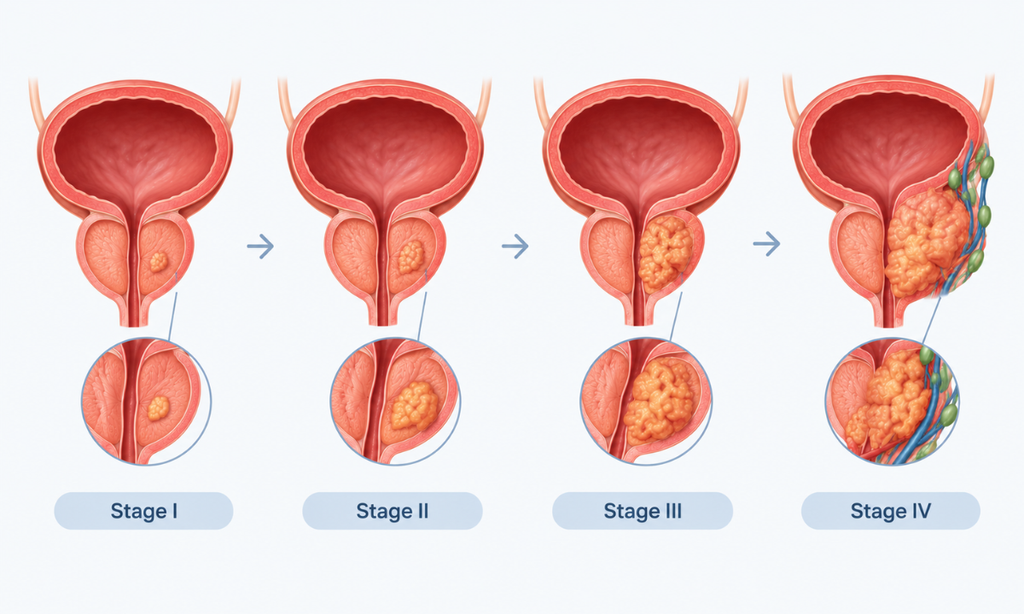
Doctors determine prostate cancer stages using the TNM system, along with PSA level and Grade Group.
| Stage | What it means |
| Stage 1 | Cancer is small, confined to the prostate, with PSA below 10 and Grade Group 1 |
| Stage 2 | Cancer remains within the prostate but is larger or has a higher Grade Group |
| Stage 3 | Cancer has grown beyond the prostate or has high-risk features such as a high PSA or Grade Group |
| Stage 4 | Cancer has spread to nearby lymph nodes or distant organs, most often bones |
Doctors also classify localised prostate cancer as low, intermediate or high risk. This risk grouping strongly influences treatment decisions. Not every cancer progresses from one stage to the next; many low-risk cancers remain stable for years.
Prostate Cancer Treatment Options
The right treatment depends on the cancer stage, Grade Group, PSA level, age, overall health and personal preferences. Many men benefit from discussing options with both a urological surgeon and a radiation oncologist.
Active surveillance
For many low-risk cancers, doctors may recommend regular monitoring through PSA tests, MRI scans and occasional repeat biopsies. Treatment begins only if there are signs the cancer is changing.
This approach can avoid or delay treatment-related side effects in men whose cancer may never need intervention.
Surgery
A radical prostatectomy removes the prostate gland and is an option for cancer that has not spread. It may be performed as open, laparoscopic or robot-assisted surgery by an experienced surgical oncologist in Bangalore.
Possible side effects include urinary leakage and erectile difficulties, though these often improve over time.
Radiation therapy
Radiation therapy may involve:
- External beam radiotherapy, which targets the prostate from outside the body
- Brachytherapy, where radioactive seeds are placed inside the prostate
For many men with localised prostate cancer, radiation therapy can be as effective as surgery. Higher-risk cancers may require radiation combined with hormone therapy.
Hormone therapy
Prostate cancer cells often depend on testosterone to grow. Androgen deprivation therapy lowers testosterone levels and slows cancer growth.
It may be used for advanced prostate cancer or alongside radiation therapy. Newer hormone medicines may be added in more advanced cases.
Chemotherapy and advanced treatments
If cancer has spread or no longer responds to hormone therapy, treatment options may include:
- Chemotherapy
- Targeted therapy for certain genetic changes
- Radioligand therapy, which delivers radiation directly to PSMA-positive cancer cells
Can Prostate Cancer Be Prevented?
There is no guaranteed way to prevent prostate cancer. However, men can support their overall health by:
- Staying physically active
- Maintaining a healthy weight
- Eating a balanced diet
- Avoiding tobacco
- Discussing personal risk factors with a doctor
The most important step is understanding your individual risk and deciding with your doctor whether PSA screening is appropriate. Early detection also helps keep cancer treatment simpler and more affordable.
When Should You See a Doctor?
See a doctor if you have:
- Persistent changes in urination
- Blood in urine or semen
- New or unexplained pain in the lower back, hips or pelvis
- A family history of prostate, breast or ovarian cancer
Men without symptoms should discuss the benefits and limitations of PSA testing from around age 50. Those with a first-degree relative who had prostate cancer, or a known BRCA gene change, may benefit from starting this conversation earlier, around age 40 to 45.
If you have concerns, the specialists at Dasappa Cancer Hospital, one of the trusted cancer hospitals in Bangalore, can review your symptoms, explain test results and guide you through the next steps with personalised, affordable cancer treatment plans.
Frequently Asked Questions
What is the first warning sign of prostate cancer?
There is often no early warning sign. When symptoms appear, urinary changes such as weak flow or frequent night-time urination are common, although these are more often caused by BPH.
Does a high PSA always mean cancer?
No. PSA can rise due to BPH, infection, recent ejaculation or vigorous exercise. Further tests are needed to determine the cause.
Is prostate cancer curable if found early?
Prostate cancer confined to the prostate can often be treated successfully with surgery or radiation. Many slow-growing cancers can also be safely monitored.
How quickly does prostate cancer spread?
It varies widely. Many prostate cancers grow slowly over years, while high-grade cancers may spread more quickly. PSA level and Grade Group help doctors estimate behaviour.
What is the difference between BPH and prostate cancer?
BPH is a non-cancerous enlargement of the prostate. Prostate cancer is a malignant growth. Both can cause urinary symptoms, so medical evaluation is needed to tell them apart.
Schedule a Consultation at Dasappa Cancer Hospital
If you, a patient, or a family member is experiencing symptoms, contact our clinical oncology team in Bengaluru for an expert evaluation:
Hospital Location: Dasappa Memorial Institute of Oncology (Dasappa Cancer Hospital), No. 132, Gandhi Bazaar Main Road, Basavanagudi, Bengaluru, Karnataka 560078
Consultation Helpline: +91 80 2667 9294 / +91 98450 12345
Website: dasappacancerhospital.com