
The future of cancer care lies in personalized cancer medicine, where treatments are tailored specifically to your unique genetic makeup and tumor characteristics.
At our cancer hospital in Bangalore, we have witnessed how individualized treatment approaches dramatically improve outcomes compared to traditional one-size-fits-all methods.
What if your cancer treatment could be designed exclusively for you, targeting only your cancer cells while sparing healthy tissue? Let me explain in detail.
Understanding Personalized Medicine

Personalized medicine represents a revolutionary shift in how we approach cancer treatment today. Instead of using standard protocols for every patient, we analyze your specific cancer profile.
This approach considers your genetic information, tumor biology, lifestyle factors, and treatment response patterns. We create treatment plans that work with your body’s unique characteristics rather than against them.
Personalized Medicine Meaning Explained
The personalized medicine meaning goes beyond customization; it’s about precision targeting at the molecular level. We identify specific mutations and biomarkers driving your cancer’s growth.
Using advanced genetic testing, we pinpoint exactly which drugs will work best for your particular cancer type. This scientific approach eliminates guesswork and maximizes treatment effectiveness from the start.
Personalized Medicine Benefits That Transform Lives
The personalized medicine benefits extend far beyond improved survival rates, though those improvements are remarkable. Patients experience fewer side effects because treatments target cancer cells specifically.
Treatment duration often shortens significantly when we use the right therapy immediately. This precision approach reduces healthcare costs by avoiding ineffective treatments and unnecessary procedures.
Recovery times improve dramatically when your body isn’t fighting harsh chemicals that don’t work. Quality of life remains better throughout treatment, allowing patients to maintain normal activities longer.
Personalized Medicine and Cancer: A Perfect Match
Personalized medicine and cancer treatment represent the most significant advancement in oncology in decades. Cancer is fundamentally a genetic disease with thousands of possible variations.
No two cancers are exactly alike, even if they occur in the same organ. Traditional treatments assume all breast cancers or lung cancers behave similarly, but molecular testing proves otherwise.
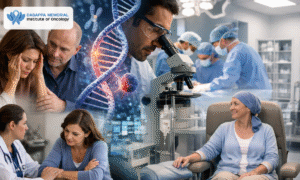
At our cancer hospital in Bangalore, we use genomic profiling to understand your cancer’s unique fingerprint. This detailed analysis reveals which pathways your cancer uses to grow and spread.
How Personalized Medicine for Cancer Works
Personalized cancer medicine begins with comprehensive molecular testing of your tumor tissue. We analyze hundreds of genes simultaneously to identify actionable mutations.
Our oncologists then match these findings with targeted therapies, immunotherapies, or precision chemotherapy combinations. This data-driven approach ensures you receive treatments most likely to work for your specific cancer.
We continuously monitor treatment response and adjust protocols based on how your cancer behaves. This dynamic approach keeps us one step ahead of cancer’s ability to adapt and develop resistance.
Personalized Medicine Breast Cancer Treatments
Personalized medicine breast cancer treatments have revolutionized outcomes for women with this disease. We now identify multiple breast cancer subtypes based on hormone receptors and genetic markers.
HER2-positive breast cancers respond to targeted drugs like trastuzumab that specifically block HER2 proteins. Hormone receptor-positive cancers benefit from endocrine therapies tailored to individual hormone profiles.
Genetic tests like Oncotype DX help us determine if chemotherapy is necessary or if hormone therapy alone suffices. This prevents overtreatment while ensuring aggressive cancers receive appropriate intensive therapy.
BRCA mutation carriers receive PARP inhibitors that exploit their cancer’s specific DNA repair weaknesses. These targeted approaches improve survival while dramatically reducing treatment side effects.
Personalized Medicine Lung Cancer Advances
Personalized medicine lung cancer treatment has transformed what was once a difficult-to-treat disease. We test all lung cancer patients for EGFR, ALK, ROS1, and other targetable mutations.
Patients with EGFR mutations take oral targeted therapy pills instead of traditional chemotherapy. These medications specifically block the abnormal proteins driving their cancer’s growth with minimal side effects.
ALK-positive lung cancer patients benefit from ALK inhibitors that achieve remarkable response rates. Immunotherapy selection also depends on PD-L1 expression levels identified through personalized testing.
Technologies Enabling Personalized Cancer Care
| Technology | Purpose |
|---|---|
| Next-Generation Sequencing | Identifies genetic mutations in tumor DNA |
| Liquid Biopsy | Detects cancer DNA in blood samples |
| Immunohistochemistry | Determines protein expression patterns |
| PET-CT Imaging | Tracks treatment response precisely |
| Circulating Tumor Cells | Monitors cancer progression in real-time |
| Artificial Intelligence | Predicts treatment response patterns |
Who Benefits from Personalized Cancer Medicine
We recommend personalized treatment approaches for virtually all cancer patients today. Advanced-stage cancers particularly benefit when standard treatments have failed or proven insufficient.
Rare cancers with limited treatment options find new hope through molecular profiling. Young patients benefit from therapies that preserve fertility and long-term health.
At our cancer hospital in Bangalore, we’ve successfully treated patients whose cancers showed no response to conventional therapy. Personalized approaches identified alternative pathways we could target effectively instead.
Getting Started with Personalized Treatment
Steps to Personalized Cancer Care:
- Request comprehensive molecular profiling of your tumor
- Discuss genetic testing options with your oncologist
- Participate in tumor board reviews with multidisciplinary teams
- Consider clinical trials offering cutting-edge personalized therapies
- Monitor treatment response through regular molecular testing
- Stay informed about new targeted therapies for your cancer type
- Seek second opinions at centres specializing in precision oncology
The Cost and Accessibility Factor
We understand concerns about the costs and availability of personalized medicine. Many insurance providers now cover comprehensive genetic testing for cancer patients.
Generic versions of targeted therapies are becoming available, significantly reducing medication costs. The long-term savings from avoiding ineffective treatments often offset initial testing expenses.
Final Thoughts
Personalized cancer medicine represents hope, precision, and better outcomes for patients facing this challenging disease. At Dasappa Cancer Hospital, we combine advanced molecular diagnostics with compassionate, individualized care for every patient.
Your cancer is unique, and your treatment should be too; that’s the promise of personalized medicine transforming lives today at our cancer hospital in Bangalore.
Frequently Asked Questions
1. What Is Personalized Care In Cancer?
Personalized care in cancer means tailoring treatment decisions to each patient’s unique tumor biology, genetic profile, preferences, and circumstances. It considers medical, emotional, and practical needs for comprehensive support.
2. What Is Personalized Medicine in Cancer Treatment?
Personalized medicine in cancer treatment uses molecular testing to identify specific genetic mutations and biomarkers in tumors, then selects targeted therapies that specifically attack those abnormalities while sparing healthy cells.
3. What Is An Example Of Personalized Medicine?
An example is using trastuzumab (Herceptin) exclusively for HER2-positive breast cancer patients identified through genetic testing, rather than giving it to all breast cancer patients regardless of HER2 status.
4. What New Cancer Drug Has 100% Success?
Dostarlimab showed a 100% complete response in a small trial of rectal cancer patients with mismatch repair deficiency. However, larger studies are needed; no drug achieves universal success across all patients.
5. Who Is Eligible For This Personalized Care?
All cancer patients are potentially eligible for personalized care. It’s particularly beneficial for advanced cancers, rare tumor types, treatment-resistant cases, and patients seeking optimal outcomes with minimal side effects.