
Deep inside your bones lies a soft, spongy tissue called Bone Marrow. Think of it as your body’s “Blood Factory”. Day and night, this factory works to produce three types of crucial workers:
- Red Blood Cells: The “Oxygen Trucks” that fuel your organs.
- White Blood Cells: The “Soldiers” that fight infections.
- Platelets: The “Repair Crew” that stops bleeding.
You might confuse Bone Marrow Cancer with Bone Cancer, but they are different. Bone Marrow Cancer might also be called blood cancer as it usually affects the blood in your body.
Bone marrow cancer means that this factory has been hijacked. Instead of producing healthy workers, the marrow starts printing “defective clones” (cancer cells).
These bad cells grow too fast and crowd out the good ones.
The result? Your oxygen trucks, soldiers, and repair crew disappear, leaving your body weak and defenseless.
In this guide, we break down the warning signs (CRAB symptoms), the different types of bone marrow cancers like Leukemia, and the real cost of treatment in Bangalore.
Disclaimer
The content provided in this blog, including the “CRAB” symptom guide, treatment descriptions, and “Factory” analogies, is for educational and informational purposes only. It does not constitute professional medical advice, diagnosis, or a treatment plan. Bone marrow cancer is a complex disease with many variants (Myeloma, Leukemia, Lymphoma). Symptoms and outcomes vary significantly from person to person. Do not delay seeking professional medical advice because of something you have read here. Always consult a qualified surgical oncologist or hematologist like Dr. Pandu Dasappa for a personalized assessment.
Financial Disclosure: The treatment costs mentioned (e.g., for Biopsies, Autologous/Allogeneic Transplants) are approximate market estimates for Bangalore (During 2025-26) and are intended for general financial planning.
Actual costs may vary based on the patient’s medical condition, room category chosen, complications during recovery, and insurance coverage. Dasappa Cancer Hospital reserves the right to update its specific service pricing without prior notice. Please contact the hospital administration directly for an official cost estimate.
Understanding Your Bone Marrow
Before we fight the enemy, we must know the battlefield.
Your bones aren’t just solid rocks. They are hollow and filled with two types of marrow:
- Red Marrow: The active factory. It is found in your flat bones (hips, ribs, skull). This is where blood is made.
- Yellow Marrow: The storage unit. It is found in long bones (arms, legs) and mostly stores fat.
Types of Bone Marrow Cancer When the Red Factory malfunctions, it leads to three main types of cancer:
- Multiple Myeloma: The cancer of Plasma Cells (a type of white blood cell). This is the most common type that affects the bones directly.
- Leukemia: A rapid cancer where the marrow produces too many abnormal White Blood Cells. These clog the blood vessels.
- Lymphoma: This usually starts in the lymph nodes but can spread into the marrow, shutting down the factory.
Have a look at the attached image in order to understand the bone anatomy. The spongy structure is what is affected in bone marrow cancer.
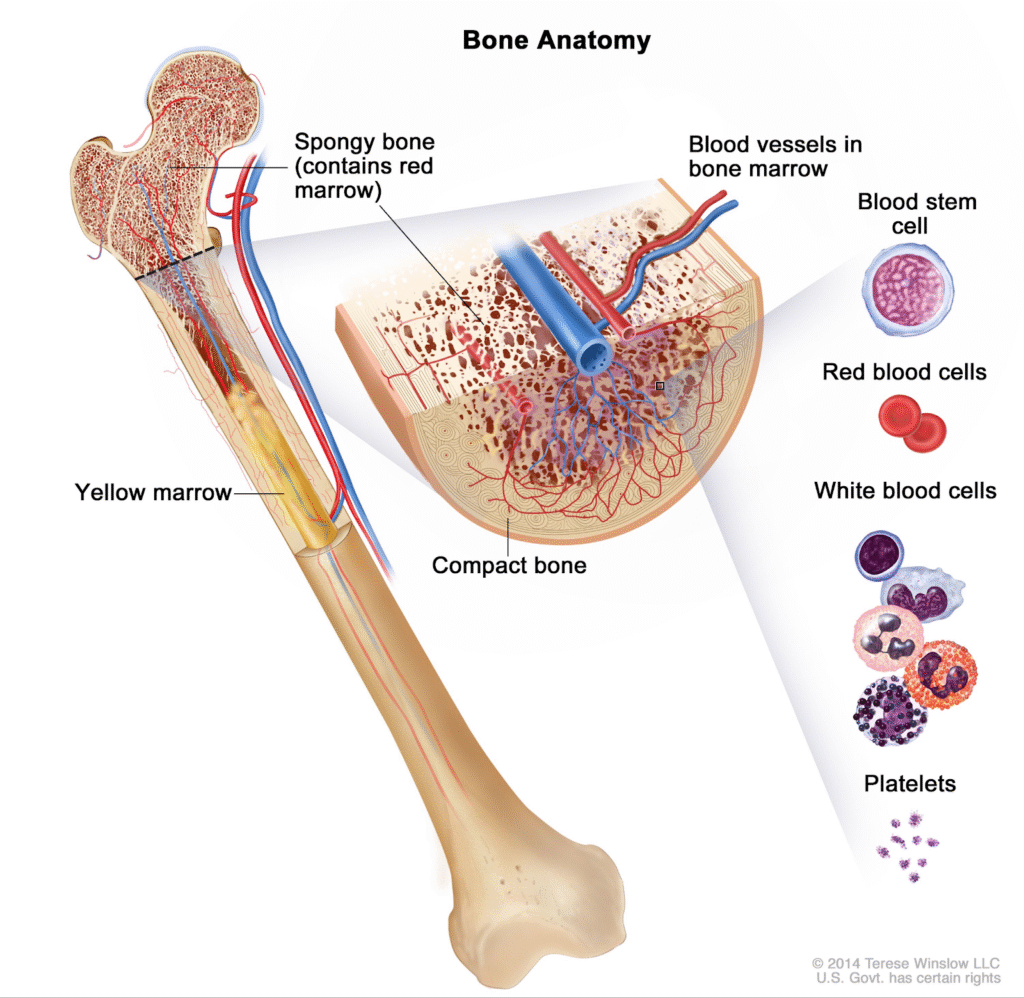
Image Credits & Source: Terese Winslow LLC U.S.Govt.
What Causes Bone Marrow Cancer?
“Did I do something wrong?” This is the first question patients ask Dr. Pandu. The honest answer is: Usually, No.
Most bone marrow cancers are Idiopathic, meaning they happen by chance.
However, to understand how it happens, let’s go back to our Factory Analogy.
- Normal Marrow: The manual says, “Print 1,000 cells, then stop.”
- Cancerous Marrow: A typo happens in the manual. Now it reads, “Print 1,000,000 cells, and NEVER stop.”
These typos are called Mutations. They can happen due to aging, chemicals, or just bad luck during cell division.
The Instruction Manual Error (DNA Mutation)
Every cell in your marrow has an instruction manual (DNA) that tells it when to grow and when to stop.
- Normal Marrow: The manual says, “Print 1,000 cells, then stop.”
- Cancerous Marrow: A typo happens in the manual. Now it reads, “Print 1,000,000 cells, and NEVER stop.”
These typos are called Mutations. They can happen due to aging, chemicals, or just bad luck during cell division.
The Risk Factor Matrix
While you can’t control luck, these factors increase the risk of a “typo” happening.
| Risk Category | The Factor | Why does it matter? |
|---|---|---|
| The Unavoidable | Age (60+) | The “Factory Machinery” gets old and makes more mistakes. Most Myeloma cases are in seniors. |
| The Chemical | Benzene Exposure | High Risk. Benzene is found in cigarette smoke, petrol fumes, and industrial solvents. It directly damages bone marrow DNA. |
| The Pre-Condition | MGUS | Monoclonal Gammopathy of Undetermined Significance. A benign condition where protein levels are slightly high. 1% of these people develop Myeloma later. |
| The Treatment | Previous Radiation | If you had radiation therapy for a previous cancer (like Breast or Lung), your marrow might have taken a hit years ago. |
The Pre-Cancer Warning: What is MGUS?
This is a concept Dr. Pandu often explains to families.
Many people don’t wake up with Multiple Myeloma overnight. It often starts as MGUS.
- Stage 1 (MGUS): The factory is printing some weird proteins, but the factory is still running fine. No symptoms.
- Stage 2 (Smoldering Myeloma): The weird proteins increase, but no damage yet.
- Stage 3 (Active Myeloma): The factory collapses. CRAB symptoms appear.
If you are diagnosed with MGUS, do not panic. It is NOT cancer yet. It just means we need to monitor your blood every 6 months to catch any changes early.
Signs Your Factory is Failing: Symptoms & False Alarms
How do you know if you have bone marrow disorders and symptoms of cancer? It rarely starts with a “lump.”
Instead, the symptoms happen because the cancer cells are crowding out your healthy cells.
When the “Factory” is full of bad clones, it cannot produce the healthy blood you need to survive.
Here is the breakdown by cancer type.
A. Multiple Myeloma: The “CRAB” Criteria
This is the Gold Standard for detecting Myeloma. If you have persistent back pain, doctors check for these four signs immediately.
| Letter | Symptom | What It Feels Like | The Medical Reason |
|---|---|---|---|
| Letter | Symptom | What It Feels Like | The Medical Reason |
| C | Calcium Elevation | Extreme Thirst & Confusion. You drink liters of water but still feel dry. You might feel “foggy” or constipated. | Cancer breaks down your bones, releasing calcium into the bloodstream. High calcium blocks brain signals. |
| R | Renal (Kidney) Failure | Swollen Legs & Foamy Urine. You feel tired and nauseous. | Your kidneys are overworked trying to filter the toxic cancer proteins. |
| A | Anemia | Breathlessness. Climbing one flight of stairs feels like running a marathon. You look pale. | The marrow is too crowded to produce Red Blood Cells (Oxygen carriers). |
| B | Bone Pain (Lesions) | Deep, Gnawing Pain. It is not sharp like a muscle pull. It feels like a dull ache inside the bone (mostly back, ribs, or hips) that gets worse at night. | The cancer eats tiny holes (lytic lesions) into the bone structure, making them weak and prone to breaking. |
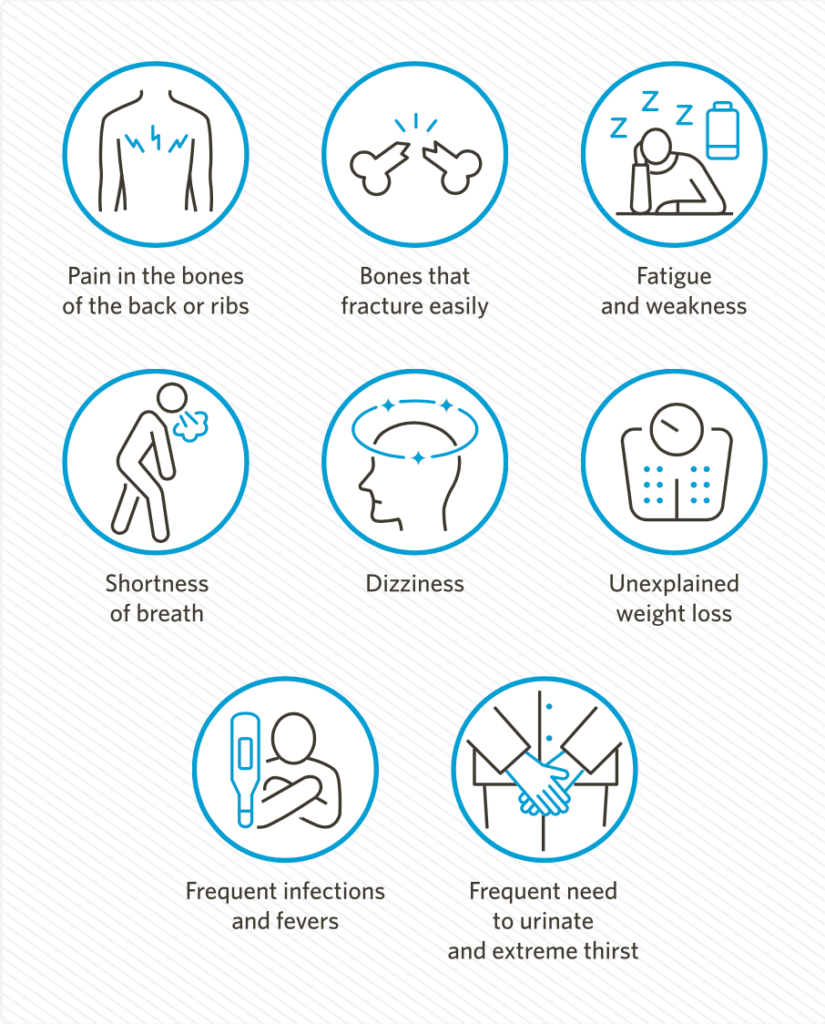
Image source: Cancer Treatment Centers of America
What is the biggest indicator of bone cancer? Unexplained Bone Pain that persists for more than 2 weeks, especially at night, is the most significant warning sign.
B. Leukemia & Lymphoma: The Shortage Symptoms
For these cancers, the symptoms appear because you are running out of healthy blood cells.
| Cell Type Affected | The Consequence | What It Feels Like |
|---|---|---|
| Low Platelets | Bleeding Issues | • Pin-point red rash (Petechiae) on legs.• Gums bleed when brushing.• Large bruises appear from tiny bumps. |
| Low WBCs | Frequent Infections | • Recurring Fever that antibiotics can’t fix.• Mouth sores or ulcers that won’t heal.• Constant flu-like feeling. |
| Systemic | High Metabolism | • Night Sweats: You wake up soaking wet (drenched sheets).• Weight Loss: Losing 5kg+ without dieting. |
C. The False Alarm: Can Bone Marrow Edema be Cancer?
Don’t panic if you see “Edema” on an MRI report.
We often see patients at Dasappa Cancer Hospital terrified by an MRI report saying “Bone Marrow Edema.” Does it mean cancer? usually, NO.
- What is it? It is simply fluid buildup (swelling) inside the bone.
- Common Causes: A recent injury, osteoarthritis, or stress fractures (common in runners).
When to worry: If the edema is accompanied by the CRAB symptoms mentioned above. Otherwise, it often heals with rest.
The 7 Warning Signs of Bone Cancer (Quick Checklist)
- Persistent bone pain (especially at night).
- Unexplained weight loss.
- Constant fatigue (Anemia) despite sleeping well.
- Frequent infections (Low immunity).
- Easy bruising or bleeding.
- A palpable lump or swelling over a bone.
- Drenched night sweats.
If you tick more than 2 of these, consult an oncologist.
Diagnosis of Bone Marrow Cancer
The most scary part isn’t always the cancer; sometimes, it is the test itself.
To confirm bone marrow cancer, doctors need to look inside the factory.
This procedure is called a Bone Marrow Aspiration and Biopsy.
Let’s be honest—Google makes this sound like torture. The reality is different. It is uncomfortable, but it is quick (15–20 minutes).
The 2-Step Procedure (What it actually feels like)
You will lie on your side. The doctor works on the back of your hip bone (Pelvic bone), NOT the spine. So be assured.
| Step | What happens? | What does it feel like? |
|---|---|---|
| 1. Numbing (Anesthesia) | The doctor injects Lidocaine into the skin and bone surface. | Sting! Like a bee sting or mosquito bite for 10 seconds. Then, the area goes numb. |
| 2. Aspiration (Liquid) | A thin needle sucks out the liquid marrow (the “workers”). | Sharp Cramp. You feel a sudden “vacuum” sensation deep in the hip for 2–3 seconds. This is the hardest part. |
| 3. Biopsy (Solid) | A larger needle takes a tiny core of the bone (the “factory wall”). | Dull Pressure. You feel someone pushing hard on your hip. It doesn’t sting, but it feels heavy. |
Don’t hold your breath. When you feel the pressure, breathe out slowly through your mouth. It relaxes the muscles and reduces pain by 50%.
Decoding Your Bone Marrow Report
Once the sample goes to the lab, you will get a complex report. Here are the 3 keywords that matter.
| Keyword | What it means | The Danger Sign |
|---|---|---|
| Cellularity | How crowded is the factory? (Ratio of cells to fat). | “Hypercellular” (Too Crowded). Means cancer cells are packing the space. |
| Blasts | The baby cells. In a healthy person, they should be < 5%. | > 20% Blasts. This is the official definition of Acute Leukemia. |
| Cytogenetics | The DNA check. It looks for “typos” in the chromosomes. | “Philadelphia Chromosome” or “Deletion 17p”. These specific mutations tell us which chemo will work best. |
Treatment of Bone Marrow Cancer
You cannot simply “cut out” bone marrow cancer like a tumor. It is in the blood. Since the “bad clones” are everywhere, the treatment must be systemic. We need to flush the entire body.
This is a multi-step process. Here is the battle plan.
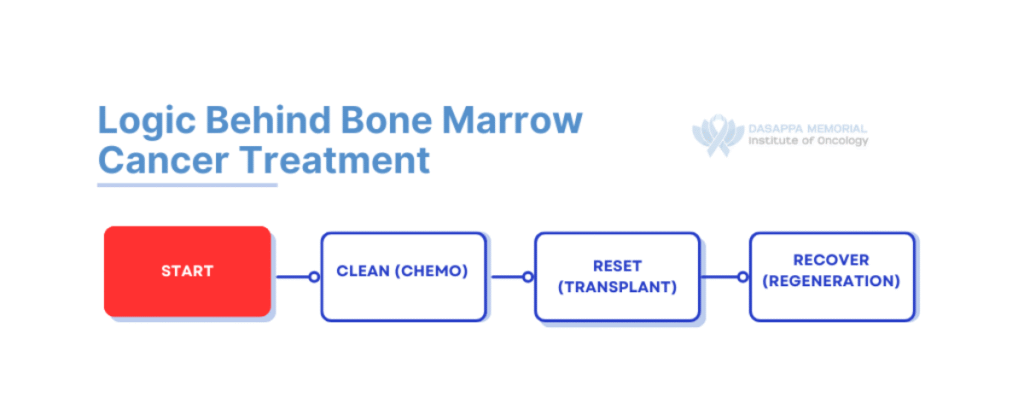
Phase 1: The Cleaning (Chemotherapy & Radiation)
“Before we can rebuild, we must destroy the enemy. Different weapons are used based on the enemy type.”
-Probably Sun Tzu, in ancient times.Types of Cancer Treatment
Chemotherapy uses strong chemicals to kill fast-growing cells in the body. While it is effective at destroying cancer cells, it also affects other rapidly dividing healthy cells such as hair follicles and the lining of the gut. As a result, chemotherapy can cause side effects like hair loss, nausea, and fatigue because it temporarily wipes out healthy cells along with cancer cells.
Targeted therapy works differently by using drugs such as Bortezomib that identify specific proteins present on cancer cells. These drugs attack only the cancer cells while largely sparing normal cells. Because of this precise approach, targeted therapy generally causes fewer side effects and less overall damage compared to chemotherapy.
Immunotherapy helps the body’s own immune system fight cancer. It works by unmasking cancer cells so that white blood cells can recognize, attack, and destroy them. In effect, immunotherapy boosts the body’s natural defenses, training the immune system to better identify and fight cancer.
Radiation therapy uses high-energy beams directed at a specific area of the body. It targets cancer cells in a localized region, such as a bone causing pain or at risk of fracture. By shrinking tumors in one precise spot, radiation therapy provides localized relief, helps reduce pain, and can prevent further complications.
Phase 2: Bone Marrow Transplantation
This is the most effective long-term cure, but also the most intensive.
If Chemo is like cleaning the floor, a Bone Marrow Transplant (BMT) is like demolishing the building and pouring a new foundation.
It is scientifically called Hematopoietic Stem Cell Transplantation (HSCT).
The Logic:
- We give you Mega-Dose Chemo to kill 100% of the marrow (Cancer + Healthy).
- The factory is now empty (Aplasia). You have zero immunity.
- We infuse fresh Stem Cells (baby cells) into your vein.
- They travel to the bones, settle in, and start a new, cancer-free factory.
Types of Bone Marrow Transplantation
Whose cells are we using? This is the critical decision.
| Feature | Autologous Transplant (Auto-BMT) | Allogeneic Transplant (Allo-BMT) |
|---|---|---|
| The Source | Your Own Cells. Collected before the high-dose chemo and frozen. | Donor Cells. From a sibling (100% match) or a Registry Donor. |
| Best For | Multiple Myeloma. (Since your own stem cells are usually not cancerous). | Leukemia. (Your own cells are corrupted, so we need a totally new immune system). |
| The Risk | Lower Risk. No chance of rejection (it’s your own body). | High Risk. The new cells might attack your body (Graft-vs-Host Disease). |
| The Cost | ₹10 Lakhs – ₹15 Lakhs | ₹20 Lakhs – ₹35 Lakhs+ |
The Regeneration Question
A common fear: “If you kill my marrow, will it ever grow back?”
Does bone marrow regenerate? YES. It is one of the few organs in the human body capable of total regeneration. Once the new stem cells are infused, they take about 14 to 21 days to Engraft (start working).
- Day 1-10: The “Empty Period.” You are kept in a sterile room because you have no soldiers (WBCs).
- Day 14: The “First Sign.” Your WBC count starts to rise.
- Day 30: The Factory is back online. You can usually go home.
Dr. Pandu’s Warning: “The transplant isn’t the end. The first 100 days after the transplant are crucial. You are like a newborn baby—highly susceptible to infections. Hygiene is your only medicine during this time.”
Treating cancer is great, but we must also fix the holes it left.
Bisphosphonates: Bone reinforcement drugs that strengthen weak bones to prevent fractures.
Kyphoplasty: If a vertebra has collapsed due to Myeloma, Dr. Pandu injects medical cement into the spine to restore height and stop pain instantly.
The Realities: Success Rates, Costs & Insurance
It’s not just about surviving the surgery; it’s about affording the life after it.
A. The Success Rate: What are my chances?
Success isn’t a coin toss. It depends on your Type and Timing.
Many patients ask, “What is the life expectancy of a person with bone cancer?” In 2026, the numbers are encouraging, especially if caught before the factory totally collapses.
| Transplant Type | Success Rate (Bangalore 2026) | Who is it for? |
|---|---|---|
| Autologous (Self) | 80% – 90% (1st Year Survival)50% – 60% (5-Year Survival) | Mainly for Multiple Myeloma. It grants a long “Remission” (cancer-free period) of 4-7 years. |
| Allogeneic (Donor) | 70% – 85% (Cure Rate) | Mainly for Leukemia. If you survive the first 2 years without relapse, you are often considered Cured for life. |
| Pediatric (Kids) | 90%+ | Kids with Thalassemia or Leukemia respond incredibly well to transplants. |
Dr. Pandu’s Reality Check: “The surgery success is high. The real battle is the First 100 Days post-transplant. If you avoid infection during this period, your long-term survival doubles.”
H3- B. The Cost Matrix: Private vs. Government
Where should you go? The trade-off is Time vs. Money.
Bone Marrow Transplant Cost in Bangalore varies wildly. Here is the honest breakdown between a top private center (like Dasappa Cancer Hospital) and a Government Institute (like Kidwai/Tata).
| Expense Head | Private Hospital (Estimated) | Government HoGovernment Hospital (Subsidized) |
|---|---|---|
| Autologous BMT | ₹10 Lakhs – ₹14 Lakhs | ₹2 Lakhs – ₹5 Lakhs |
| Allogeneic BMT | ₹18 Lakhs – ₹25 Lakhs | ₹8 Lakhs – ₹12 Lakhs |
| Donor Search (Registry) | ₹5 Lakhs – ₹10 Lakhs | Waiting List (Very Long) |
| Room Quality | HEPA-Filtered Private Suite | Shared Sterile Wards |
| Waiting Time | Immediate (1 week) | 3 – 6 Months |
Why the difference? In BMT, you are paying for Sterility. A private room with a dedicated HEPA filter (air purifier) costs ₹15k/day. In Government hospitals, infection rates can be higher due to shared facilities.
C. The “Insurance Shield” & Government Help
Does Health Insurance cover Bone Marrow Transplants?
YES, but read the fine print.
- Standard Mediclaim: Usually covers the Hospitalization Bill (Room + Surgery).
- Critical Illness Rider: Pays a lump sum (e.g., ₹20 Lakhs) directly to you. This is crucial for post-care medicine costs.
- The “Donor” Clause: Most policies DO NOT pay for the Donor’s hospitalization (approx. ₹1-2 Lakhs). Check if your policy has “Organ Donor Coverage”.
Government Schemes (For Low Income):
- Ayushman Bharat (PMJAY): Covers up to ₹5 Lakhs. This can fully fund an Autologous transplant in a government hospital.
- Suvarna Arogya Suraksha (Karnataka): Specific help for BPL card holders in Bangalore.
- Prime Minister’s Relief Fund: Can be applied for if you need an expensive Allogeneic transplant.
Conclusion
A diagnosis of bone marrow cancer feels like the ground beneath you is crumbling. But remember the Factory Analogy.
Even if the factory is shut down, modern science allows us to clean it, repair it, or even build a completely new one.
The journey isn’t easy. It involves complex decisions—from understanding your bone marrow report to choosing between Autologous or Allogeneic transplants.
You don’t just need a surgeon; you need a strategist.
This is where Dasappa Cancer Hospital stands apart. We don’t just treat cancer; we treat the patient.
Whether it is managing the pain of Multiple Myeloma or navigating the intense recovery of a transplant, Dr. Pandu Dasappa ensures you never walk this path alone.
Finding the right Cancer treatment hospital in bangalore is about finding a partner who values your life as much as you do. If you are looking for honest advice, ethical pricing, and world-class care, trust the Best cancer hospital in Bangalore. Let’s get your factory working again.
Frequently Asked Questions (FAQs)
Q1: How serious is cancer in the bone marrow?
It is a serious, life-altering condition because it affects your blood’s ability to fight infection and carry oxygen. However, it is no longer an automatic “death sentence.” With modern Targeted Therapy and Transplants, many patients live normal lives for 10+ years in remission.
Q2: What is the biggest indicator of bone cancer?
Persistent Bone Pain. Unlike a muscle ache, this pain is deep, gnawing, and often gets worse at night or when you are resting. If back pain lasts more than 2 weeks without injury, get checked.
Q3: What are the 7 warning signs of bone cancer?
Think of the “CRAB” signs plus general health decline:
- Deep Bone Pain (Back, ribs, hips).
- Unexplained Fracture (Bones breaking easily).
- Extreme Fatigue (Anemia).
- Frequent Infections (Low immunity).
- Unexplained Weight Loss.
- Night Sweats (Drenching).
- Swelling or a lump over a bone.
Q4: What is the life expectancy of a person with bone cancer?
This depends entirely on the “Type” and “Stage.”
- Multiple Myeloma: The 5-year survival rate is now over 55%, with many living 10+ years.
- Leukemia: For younger patients with a successful transplant, the cure rate can be 80-90%.
- Note: Statistics are just numbers. Your specific biology matters more.
Q5: Does bone marrow regenerate after donation or chemo?
Yes. Bone marrow is one of the fastest-regenerating tissues in the body.
- For Donors: Your levels return to 100% within 4 to 6 weeks.
- For Patients: After a transplant, the new cells “engraft” and start producing blood within 14 to 21 days.
Sources
For Primary Data: Government & Medical Authorities
Used to define the precise types of Stem Cell Transplants (Autologous vs. Allogeneic) and their mechanisms. Cancer.gov – Stem Cell Transplant
Used to verify the CRAB symptoms for Multiple Myeloma and the explanation of bone marrow disorders. MedlinePlus – Bone Marrow Diseases
Used to reference Ayushman Bharat (PMJAY) coverage limits for tertiary cancer care in the Financials section. PMJAY Scheme Details
Clinical & Symptom Verification:
1. Healthline – Bone Marrow Cancer,
2. Max Healthcare – Bone Marrow Cancer Symptoms
For Images: Google Images (linked source below each image, no violation of copyrights as the credits are given)