
Cervical cancer presents a tragic paradox in modern medicine. It is one of the most deadly cancers among Indian women, yet it is also the only cancer that is almost 100% preventable.
In India alone, it accounts for approximately 18% of all cancer cases in women, often striking during the prime productive years of life (ages 35–55).
Unlike other malignancies that grow rapidly, cervical cancer provides a massive “window of opportunity”, often taking 10 to 15 years to develop from a viral infection to a dangerous tumor.
At Dasappa Cancer Hospital, we believe that the tragedy of this disease lies not in its aggression, but in its silence.
Most women only seek help when symptoms appear, by which time the disease has often advanced.
In this guide, we will break down the cervical cancer causes, the subtle warning signs, and the cervical cancer vaccine price in Bangalore, empowering you to catch this disease while it is still just a whisper, not a crisis.
Medical Disclaimer
For Informational Purposes Only The content provided in this blog, including text, graphics, images, and other material, is for educational and informational purposes only. It is not intended to be a substitute for professional medical advice, diagnosis, or treatment.
Consult a Specialist Always seek the advice of your physician, oncologist, or other qualified health provider with any questions you may have regarding a medical condition. Never disregard professional medical advice or delay in seeking it because of something you have read on the Dasappa Cancer Hospital website.
No Doctor-Patient Relationship Reading this blog or interacting with the content does not establish a doctor-patient relationship between you and Dasappa Cancer Hospital or any of its specialists.
Emergency Situations If you think you may have a medical emergency, severe bleeding, or acute pain, please call your doctor or visit the nearest emergency department immediately.
Accuracy of Information: While we strive to provide the most accurate and up-to-date medical information based on global guidelines (WHO, NCI, FOGSI), medical knowledge is constantly evolving. Dasappa Cancer Hospital does not guarantee that all information is completely current or error-free at all times.
What is Cervical Cancer?
Understanding the Anatomy of the “Silent” Organ
To understand why this cancer hides so well, we must first understand the anatomy of the cervix itself.
Cervical Cancer is a malignant neoplasm arising from the cells of the Cervix Uteri (the lower fibromuscular portion of the uterus).
It predominantly begins in the Transformation Zone, a specific area where two types of cells meet: the squamous cells of the outer cervix (exocervix) and the glandular cells of the inner canal (endocervix).
- Squamous Cell Carcinoma: Accounts for 90% of cases. It arises from the flat, skin-like cells of the exocervix.
- Adenocarcinoma: Accounts 10% of cases. It arises from the mucus-producing gland cells of the endocervix.
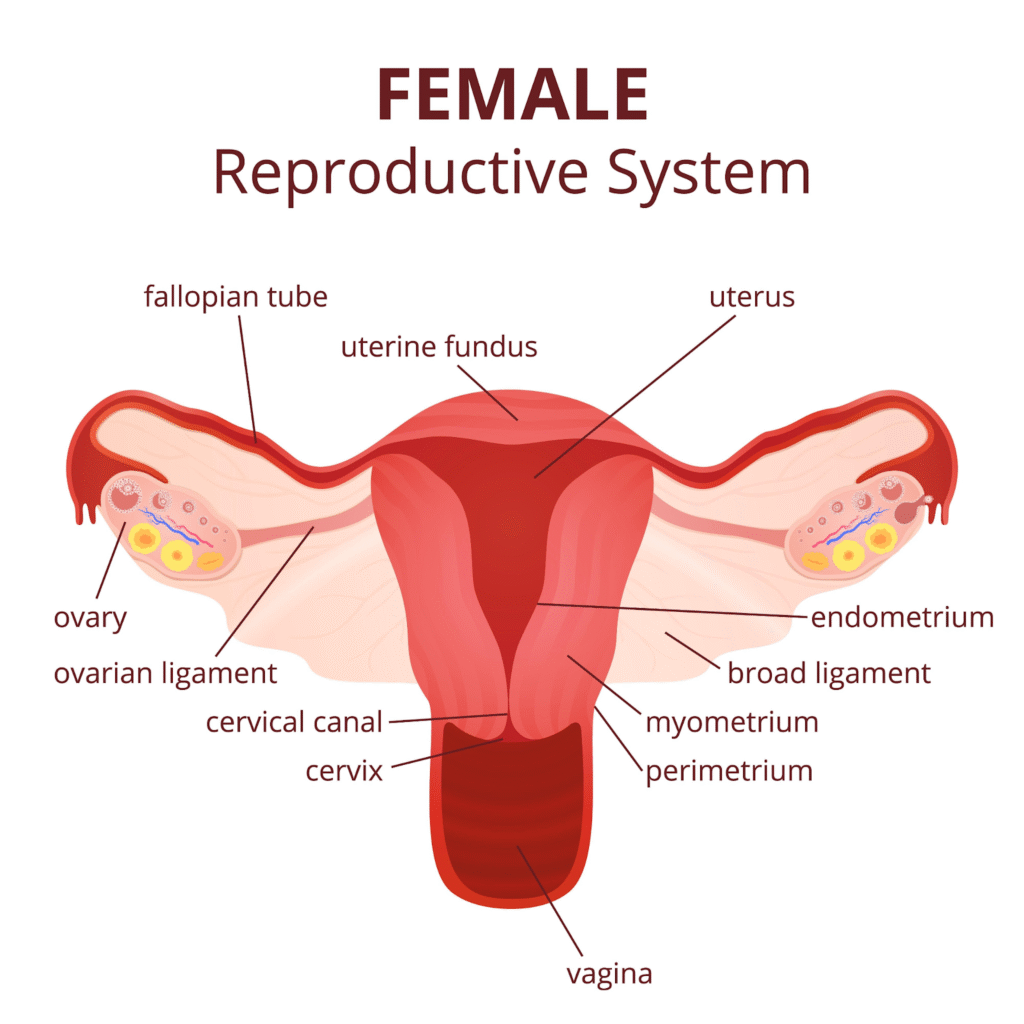
Think of the Uterus (Womb) as a house where a baby grows. The Cervix is the “Front Door” of that house.
- Function: It stays tightly closed to keep the baby safe during pregnancy and opens only during childbirth.
- The Problem: Because this “door” is constantly exposed to friction, bacteria, and viruses (from sexual activity), it undergoes constant repair.
- The Cancer: Imagine a common virus (HPV) enters this door lock. Instead of causing immediate damage, it sits there for years, slowly rusting the lock mechanism. Over a decade, this rust (abnormal cells) spreads until the door’s structure collapses entirely.
Why is it called “Silent”? The cervix has few pain receptors (nerves). You can have advanced “rust” (lesions) on your cervix and feel absolutely no pain or discomfort.
You might have normal periods and feel energetic, even as the cells are mutating.
This is why waiting for pain is a dangerous strategy, by the time it hurts, the cancer has usually spread to nearby nerves or bones.
What Causes Cervical Cancer?
It is not just “bad luck.” It is a specific virus.
For decades, the cause of cervical cancer was a mystery.
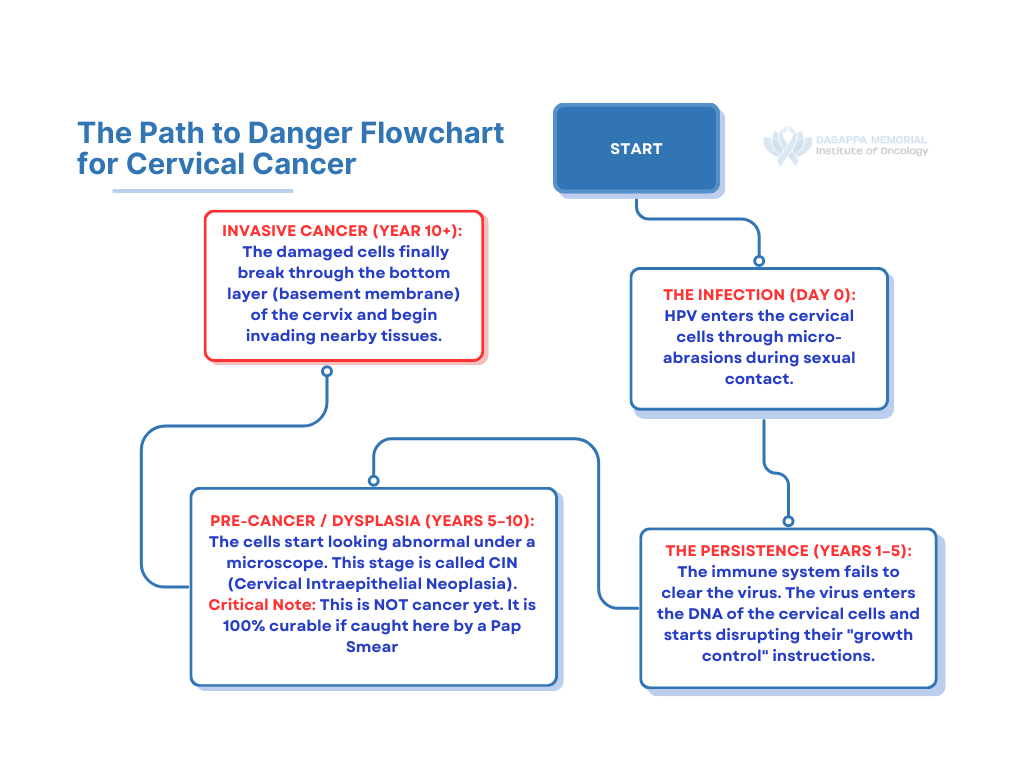
Today, science has given us a definitive answer: 99.7% of cervical cancer cases are directly linked to a virus called HPV (Human Papillomavirus).
Meet the Culprit: HPV
HPV is not a rare disease. It is so common that nearly 80% of sexually active adults will get it at some point in their lives.
- The Good News: In most women, the body’s immune system recognizes the virus and clears it naturally within 2 years, just like a common cold.
- The Bad News: In a small percentage of women, the virus refuses to leave. It becomes a Persistent Infection.
- The “High-Risk” Strains: There are over 100 types of HPV. Most cause harmless warts on hands or feet. However, HPV-16 and HPV-18 are the aggressive “High-Risk” strains responsible for 70% of all cervical cancers globally.
Cervical cancer is a slow-motion disaster.
It does not happen in weeks or months. It typically takes 10 to 15 years (or even 20) for a persistent viral infection to mutate into a life-threatening tumor.
While HPV is the seed, other factors act like fertilizer, weakening your body’s ability to fight the virus and speeding up the cancer timeline.
Other Risk Factors (The Accelerators)
- Smoking: This is a major co-factor. Tobacco byproducts have been found in smokers’ cervical mucus. They damage the DNA of cervix cells, making it harder for the immune system to clear the HPV infection.
- Weak Immune System: Women with HIV/AIDS or those taking immunosuppressant drugs are at higher risk because their bodies cannot fight the “Persistent Infection.”
- Long-term Oral Contraceptives: Studies suggest that using birth control pills for 5 years or more may slightly increase risk, though the risk drops after stopping.
- Multiple Full-Term Pregnancies: Women who have had 3 or more full-term pregnancies have a slightly higher risk, likely due to hormonal changes and cervical trauma.
Dr. Dasappa’s Note: “Many patients ask: ‘I have been married for 20 years. How can I have HPV now?’ The virus is tricky. It can remain dormant (sleeping) in your body for decades after infection. A positive test at age 45 doesn’t mean a new infection; it often means an old infection has just woken up due to age or stress.”
Symptoms & Warning Signs
Why waiting for pain is a dangerous strategy.
The scariest aspect of cervical cancer is its ability to hide in plain sight. In the Early Stages (Pre-Cancer & Stage I), there are usually ZERO symptoms.
The cancer is microscopic. It hasn’t invaded any nerves or blood vessels yet.
You can look healthy, feel energetic, and have normal periods, all while the cells are mutating inside.
However, as the tumor grows and invades nearby tissue, it starts sending out specific warning signals.
The #1 Symptom: Abnormal Bleeding
If you notice bleeding when you shouldn’t be bleeding, pay attention. This is the cancer’s way of telling you that the tissue is fragile and breaking down.
| Scenario | What it Feels Like | Why it Happens | Urgency Level |
|---|---|---|---|
| Bleeding Between Periods | Spotting or light flow when your period is not due. | The tumor creates new, fragile blood vessels that burst easily. | High |
| Bleeding After Sex (Post-Coital) | Seeing blood or pink discharge immediately after intercourse. | Friction during sex damages the sensitive tumor surface (Contact Bleeding). | CRITICAL (Classic Sign) |
| Bleeding After Menopause | Any bleeding after you have stopped menstruating for 12+ months. | The cervical lining is shed by malignant growth, not hormones. | EMERGENCY |
| Heavier Periods | Menstrual flow that is heavier or lasts longer than your usual cycle. | The tumor increases the surface area of bleeding tissue. | Medium |
Other Common Symptoms (Advanced Stages)
As the cancer spreads beyond the cervix to the vagina, pelvic muscles, or nearby organs (bladder/rectum), you may experience:
- Unusual Vaginal Discharge:
- It may be watery, pink, or brown.
- It often has a foul or unpleasant odor (caused by dying tissue).
- Pelvic Pain:
- A dull, constant ache in the lower belly or back that doesn’t go away with rest.
- Pain during intercourse (Dyspareunia).
- Leg Pain & Swelling:
- If the tumor presses on the nerves or lymph nodes in the pelvic wall, it can cause a swollen leg or sharp pain shooting down one leg.
- Urinary/Bowel Issues:
- Blood in urine, pain while peeing, or sudden changes in bowel habits (signs the cancer has touched the bladder or rectum).
Dr. Dasappa’s Warning: “Do not ignore ‘Contact Bleeding.’ If you bleed after intimacy or a pelvic exam, do not assume it is ‘roughness’ or ‘dryness.’ In women over 30, this is the single most specific sign of cervical pathology. Get a checkup immediately.”
The Shield: Screening & Diagnosis
How to catch the enemy before it attacks.
Since cervical cancer takes 10–15 years to develop, we have a massive advantage. We can find the problem while it is still in the “Pre-Cancer” stage. This is done through Cervical Cancer Screening.
The Two Main Tests
Think of your cervix as a floor. You want to check if it’s clean (healthy) or if there is dirt (abnormal cells).
1. The Pap Smear (Pap Test)
- What it does: It looks for cell changes (the “rust” on the door).
- The Procedure: It is a 5-minute OPD procedure. The doctor uses a small brush to gently “sweep” a few cells from the cervix.
- Is it painful? No. It may feel slightly uncomfortable (like a pinch), but it is not painful. It requires no anesthesia.
2. The HPV DNA Test
- What it does: It looks for the virus itself (the “intruder”).
- Why it’s better: It can predict your risk years before any cell changes actually happen. If you are HPV-negative, your risk of developing cancer in the next 5 years is almost zero.
Who Should Get Screened? (The Timeline)
The guidelines have changed. You do not need a Pap smear every year anymore if your results are normal. According to the American Cancer Society and Indian guidelines:
| Age Group | Recommendation | Frequency |
|---|---|---|
| Under 21 | NO Screening. | Your immune system is still developing. Most HPV infections here clear up on their own. |
| Age 21 – 29 | Pap Smear Only. | Every 3 Years. |
| Age 30 – 65 | Co-Testing (Best Option):Pap Smear + HPV DNA Test together. | Every 5 Years (if both are negative). |
| Over 65 | Stop Screening. | You can stop if your last 3 tests were normal. |
Dr. Tip: “Even if you have taken the vaccine, you MUST still get screened. The vaccine protects against the main cancer types, but not all of them.”
What if the Result is Abnormal? (Diagnosis)
If your screening comes back positive, do not panic. It does not mean you have cancer. It means further investigation is needed.
- Colposcopy: The doctor uses a special magnifying instrument (a microscope with a light) to look closely at the cervix.
- Biopsy: If they see a suspicious white patch, they will take a tiny piece of tissue to send to the lab.
- Diagnosis Confirmation: The pathologist confirms if it is just inflammation, Pre-Cancer (CIN 1, 2, 3), or actual invasive cancer.
Prevention: The “Cancer Shield” (Vaccine & Pricing)
Did you know there is a vaccine that can prevent cancer?
This is the most powerful tool we have.
The HPV Vaccine trains your body to recognize and destroy the virus before it can damage your cervical cells.
It is not a cure for existing cancer, but it is a nearly perfect shield against future infection.
The Options: Which Vaccine Should You Choose?
In Bangalore, you currently have three main options. They vary by Coverage (how many virus types they stop) and Cost.
Table: Cervical Cancer Vaccine Price in Bangalore (2026 Estimates)
| Vaccine Brand | Strains Covered | Protection Against | Approx. Price (Per Dose) |
|---|---|---|---|
| Cervavac (Serum Institute) | 4 Types (6, 11, 16, 18) | Covers 70% of cancers + Genital Warts. | ₹1,800 – ₹2,200Most Affordable. |
| Gardasil 4 (Merck) | 4 Types (6, 11, 16, 18) | Same as Cervavac but is the international standard brand. | ₹3,800 – ₹4,200 |
| Gardasil 9 (Merck) | 9 Types (Broadest) | Premium Protection. Covers 90% of cancer causing strains. | ₹9,500 – ₹10,800 |
Note: Prices vary between local clinics and large hospitals like Dasappa Cancer Hospital. To get the best protection-to-cost ratio, Cervavac is a revolutionary “Made in India” option approved by the Govt of India.
Who Should Take It? (The “Golden Window”)
The vaccine works best before you are exposed to the virus (i.e., before sexual activity).
- The Best Time (Age 9 – 14):
- Doses Needed: Only 2 Doses (Gap of 6 months).
- Why: Their immune response is so strong that 2 doses are enough for lifetime protection.
- The “Catch-Up” Time (Age 15 – 26):
- Doses Needed: 3 Doses (0, 2, and 6 months).
- Why: Older immune systems need that extra booster.
- The “Late” Window (Age 27 – 45):
- Can I still take it? YES.
- FDA approved. While you may have already been exposed to one strain of HPV, the vaccine can still protect you from the other aggressive strains you haven’t caught yet.
Dr. Dasappa’s Advice: “If you have a daughter aged 9 to 14, vaccinate her now. It is the greatest gift of health you can give her. It effectively removes the risk of cervical cancer from her future.”
Stages & Treatment: It is Not Always a Hysterectomy
Understanding your roadmap to recovery.
If you have been diagnosed, the first question is usually, “How bad is it?” Doctors determine this by “Staging”, checking if the cancer is just on the cervix or if it has packed its bags and traveled elsewhere.
The Stages of Cervical Cancer (Simplified)
Cervical Cancer Treatment Options
Your treatment depends entirely on the stage.
At Dasappa Cancer Hospital, we customize the plan based on two factors: Did we catch it early? and do you want to have children in the future?
1. Surgery (Removing the Tumor)
- LEEP / Conization (Stage 0): A simple electric wire loop shaves off the abnormal cells. No hospital stay required.
- Hysterectomy (Standard): Removal of the uterus and cervix. This is the cure for most early-stage cancers.
- Radical Trachelectomy (The Fertility Saver):
- For young women who want babies.
- We remove only the cervix and top of the vagina, but leave the uterus intact.
- Result: You can still carry a pregnancy later (usually via C-section).
2. Radiation Therapy High-energy X-ray beams are used to kill cancer cells.
- External Beam: Like an X-ray from the outside.
- Brachytherapy (Internal): A tiny radioactive seed is placed inside the vagina for a few minutes to blast the tumor directly while sparing healthy organs.
3. Chemotherapy Powerful medicines (injected into veins) circulate through the whole body to kill any cancer cells that might have floated away from the cervix. It is often combined with radiation for Stage II and III.
When dealing with intimate health, you need more than just a surgeon. You need a partner who understands dignity. As a leading Gynecological Cancer Treatment Hospital in Bangalore, we specialize in:
- Organ Preservation: Prioritizing fertility-sparing surgeries whenever safe.
- Minimally Invasive Oncosurgery: Using laparoscopic (keyhole) techniques for faster recovery and smaller scars.
- Comprehensive Care: From the first Pap Smear to advanced Radiation, everything is under one roof.
Conclusion
Cervical cancer is a unique enemy.
It gives us a decade-long head start, a clear warning system (Pap Smear), and a powerful shield (Vaccine). Yet, it continues to claim lives simply because we delay looking for it.
Silence around “private parts” should not cost you your life.
Whether you are a young professional in Electronic City or a grandmother in Jayanagar, the rules are the same: Screening saves lives. You do not need to wait for bleeding or pain.
You just need to take one hour out of your year to check that “Front Door.”
At Dasappa Cancer Hospital, we are more than just a treatment center; we are your partners in prevention. Recognized as a leading Cancer treatment hospital in Bangalore, we combine world-class diagnostics with compassionate, judgment-free care.
Don’t let embarrassment be the reason for regret. Book your screening today. Take control of your story.
Frequently Asked Questions (FAQs)
Q1: Is Cervical Cancer contagious?
The cancer itself is not, but the cause (HPV) is. You cannot “catch” cancer from someone, but you can catch the Human Papillomavirus (HPV) through sexual contact. This is why vaccination is recommended for both partners, not just women, to stop the transmission chain.
Q2: Can I get pregnant after cervical cancer treatment?
It depends how early we catch it.
- Stage 0 or Early Stage I: Yes. With “Fertility-Sparing Surgery” (removing only the cervix), you can still carry a pregnancy, though you may need a C-section.
- Advanced Stages: If a Hysterectomy (removing the uterus) or Radiation is needed, natural pregnancy is impossible. This is why early detection at the Best cancer hospital in Bangalore is critical for young women.
Q3: Does the HPV vaccine have side effects?
Only mild ones. The HPV vaccine is extremely safe and used worldwide. Common side effects are just a sore arm (where the injection was given) or a mild fever for a day. It does not cause fertility problems or hormonal imbalances.
Q4: Do I still need a Pap smear if I have taken the vaccine?
YES, absolutely. The vaccine protects against the “Major Villains” (HPV 16 & 18), which cause 70% of cancers. However, there are other rarer strains that can still cause issues. Screening is your safety net for that remaining 30% risk.
Sources:
- Indian Clinical Guidelines & Vaccine Data: FOGSI – GPCR for Cervical Cancer
- Serum Institute of India: Serum Institute of India – CERVAVAC Product Info
- World Health Organization (WHO): WHO – Cervical Cancer Fact Sheet
- Centers for Disease Control and Prevention (CDC): CDC – HPV and Cancer